Thursday, 2 April 2015

In Deepest Yemen - With The Heavily-Armed Hamsters

* A Few Years Ago......I went to Yemen by mistake. 
It may sound strange, but at the time I was writing travel pieces (still do, available for hire, cross my palm with silver). But being a freelancer, I was at the bottom of the pile when it came to press trips. 
There were three kind of travel junkets in newspapers. The first, were the ones you never heard about. You would just realise that somebody got a free fortnight in the Bahamas or Australia when the news-editor turned up after a being off with a deep tan. In January. The second, the week in Spain or Italy, went to the staffers. The third, the Weird Ones, went to us freelancers.
Yemen At Bottom Of Map
And so it was that I ended up going to Yemen. A place that is now in the news thanks to tragic events. The Iranians and the Saudis have joined in an already volatile situation - bombing and killing in a bid to find out which version of Early Medieval mysticism is the correct one.

And every time I hear about the conflict there, my heart sinks a little - because going to Yemen was an amazing  if accidental experience.

I took the trip on a last-minute, "Yeah, Sure why not?".

It was the weirdest place I have ever been too (and I talk as somebody who once bounced around the highlands of Uganda and Rwanda for ten days. AND trekked thru deepest Leitrim). But it was ....stunning, other-worldly. In parts, it was as if we stepped out of our Toyota Jeep and straight into the 13th century. 
And I did drugs with heavily-armed hamsters. AK47s and all. Talk about an Idiot Abroad.....
Me With My Bros - Highlands of Yemen
'You're going WHERE?" It was the standard and understandable response when I told people I was about to go to Yemen for some sight-seeing. There are places where we go on holiday (Spain, France, Italy), places we go travelling (Peru, Vietnam and Tibet) and places which, for even the most committed global wanderers, are fated to remain forever off the map. Yemen was definitely one of those places for me. The only thing I knew about it was that it was somewhere near Somalia (in the news then because of recent piracy in the Arabian sea) and Chandler from Friends once had to go there in a bid to escape from his annoyingly-voiced girlfriend, Janice. Also! Bonus Strange Yemen fact, English comedian Eddie Izzard was born there.
A quick Google later and that vast caché of knowledge had expanded to include: where it is (at the bottom of the Arabian peninsula underneath Saudi Arabia); some economic facts (very little oil, poorest state in the Gulf region); and a little bit of history. Yemen was the land of the Biblical Queen of Sheba (one of the rulers of the ancient Sabaean Kingdom) and was known to the Romans as Arabia Felix, or 'Happy Arabia', because of the riches generated by the spice and incense trade.
The Republic of Yemen is slightly smaller than France, has a rapidly expanding population of around 21 million, and many of them are daily users of a narcotic plant called Qat (more of which later). Yet even knowing all of this this could not have prepared ne for the culture shock of landing in the ancient capital Sana'a at 7am on a Saturday after a 12-hour flight via Cairo, or the hypnotic calls to prayer of the muezzins bouncing off the mudbrick high-rises.
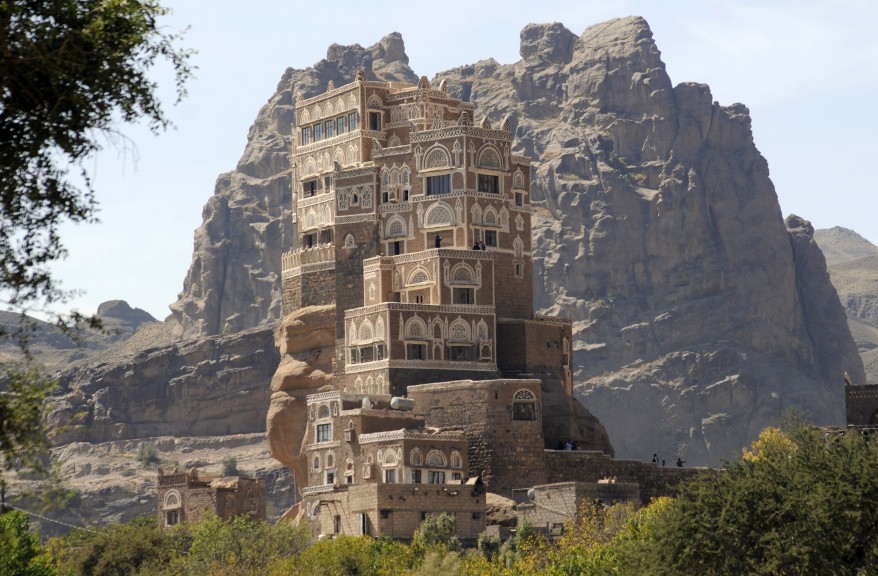
An old Yemani Royal Palace - Made Out of Marzipan. 

It's one of the weird side-effects of 21st-century travelling. You leave your familiar surroundings in Dublin one grey morning and within half a day, you are standing, bewildered, in the middle of a crowd scene from Arabian Nights as women in full-length black sharshafs shove past you, with only their dark eyes showing through narrow slots in their veils. Sana'a itself, once you start to get your head around it, is a lofty 2,000m above sea level and appears, at first glance, to be the capital of one of the dustier planets from Star Wars (especially when the moon looms hugely out of the high desert sky). Five or six-storey mud brick buildings, with roofs and floor levels picked out in black, white or red stone and whitewash framed arabesque stained-glass windows, crowd inside ancient walls.
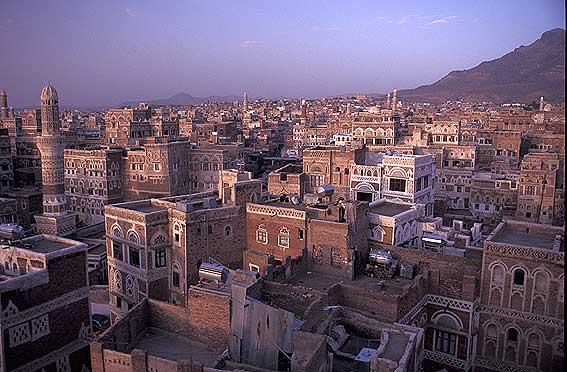
The Capital Sann'a - Mud-brick Sky-Rise

Like much of the rest of the country, it's dusty and crowded, weird and wonderful, and incredibly beautiful all at the same time. The Yemeni tourism ministry had arranged for a driver and a guide to meet myself and my two travelling companions, a young Englishman and a fiftysomething Englishwoman with a lot of experience of the Middle East.
"Hello, where are you from?" (the standard question from all Yemenis and one that we would hear at least 20 times a day over the coming week, there not being a lot of foreigners around). When we informed our guide, a local man who had lived in Canada, that we were "one Irlanda and two English", he made an executive decision. "It's better if you say you are all from Ireland -- too many questions about Bush and Blair," he said. Score one for the former colonies (Irish and Yemeni) and a week of stiff upper lip declarations of Gaeldom from my English travelling companions.
Of course, the fact that Yemen has long been on the British Foreign Office list of countries you should not travel to -- under the reassuring headings of 'Terrorism', 'Kidnapping' and 'Hostages' -- may have also informed our guide's advice. At the time we visited, there had been several incidences of tourist kidnappings. And botched rescue attempts by the Yemeni army. There was a long list of incidents such as the one in July, 2007, when eight Spanish and two Yemeni nationals were killed and a number of others injured in a suicide bomb attack in Ma'rib, 100km east of Sana'a. We could only travel outside Sana'a, with an official guide and, every 100km or so, there are army checkpoints that record your passing through and inform the next checkpoint down the line when to expect you. "If we don't show up in a couple of hours, then they will come looking for us," explained the guide, with the nonchalance of a man who was never going to be suspected of being a close personal friend of George W Bush..
Within hours of landing in Sana'a, we were going through our first checkpoint as we began our long climb up into the Haraz mountains. And after the exotic otherness of the ancient capital, this was where the great secret of Yemen was revealed. While the east of Yemen is classic Arabian desert, the western half is spectacularly, jaw-droppingly beautiful mountain country. We climbed from a high desert plateau into endless jagged mountain ranges, with every mountain top and foreboding rock crowned with a heavily fortified village that appeared to be made out of blocks of marzipan. Every mountainside is terraced in the style that would be familiar to people who have travelled through the former Inca empire in Peru. At the top of each mound rising above us were yet more impossibly beautiful castles in the air under milky-blue, Alpine skies.

The Village of Al Hajjara - very typical of mountaintop villages in Yemen

Our four days in the mountains went roughly like this: get up at 6am for breakfast, climb into the Land Cruiser, drive vertically for six hours (stopping off for lunch in fly-blown mountain villages), walk for two hours from one village to another over knife-edge ridges, then find a ramshackle guest house for an evening meal and bed. The hotels/guest houses were mostly primitive, but usually clean and very welcoming.
There were some hitches. At the mountain village of Manakha, the four brothers who owned the local hotel we stayed in played music and performed a traditional dance while we sat cross-legged on the floor eating rice, flatbread and spicy goat meat (which I love). There was a collection of dusty old rifles in the corner. I picked one up (an ancient British Lee Enfield), thinking it was an ornament. When I pulled back the bolt, I saw the live round in the chamber. My shock produced a few laughs from our hosts.
Yemani Man With Jambiyya - Pic BY Ashley Jonathan Clements

Now, no man in Yemen is ever seen without his traditional J-shaped Jambiyya dagger in his belt, in the way that our granddads would have never gone outside the door without their caps. And the traditional dance performed for us that night was, as far as I could make out, the famed 'Brandishing the Fearsome Daggers Under the Noses of the Terrified Tourists Dance'. But in a country where you regularly see guys wandering around the markets with AK47s, it wasn't that scary -- at least not until they picked up their rifles for the big finale. Thankfully, nobody was seriously injured and when midnight came, we retired to our bedrooms on the third floor.
And that was when the fun began. As well as the knives and guns, most males in Yemen spend virtually every afternoon chewing Qat, a mountain bush that apparently has mild cocaine-like affects. It's chewed like tobacco, which makes the men, chawing on huge wads of green leaves in their cheek pouches, look like heavily armed hamsters. I actually tried some with the Homicidal Manaka Brothers, sat in the room with about 14 guys chewing away for a while. And all it did was keep me awake for 48 hours. Which would prove to be a bit of a problem. Late that night, as we settled down to sleep, our armed and by now drug-addled hosts decided to put a fourth floor on the hotel, using a cement mixer, pneumatic drills and hammers. At about 4am, my fourth attempt to get them to stop saw me come as close as I ever want to be to starting a knife-fight with a tooled-up, drug-crazed dance troupe. I was standing there in my shorts, screaming threats at any man who picked up a drill. Remarkably fool-hardy given they had a stack of AKs next to the shovels.

All very colourful (and true, I swear), but not representative of a country where I always felt safe and the people were gentle, friendly and delighted to meet foreigners.

But there is a reason that people still live on the highest rock of the highest mountain. And men often carry around automatic rifles. A reason that we have been reminded of in the past couple of weeks, with the Saudis and Iranians (and all the rest of the neighbours) joining in the civil war to fight a proxy, sectarian war. The utter bastards.

So now Yemen is about bombs and terrorism. But when I see the headlines, I remember how, when I went into the highlands, a pocketful of cheap pens (the man from the tourist ministry told us to buy some in the capital) would win lots of smiles and Kodak moments from the kids who popped up from behind every boulder and wall.

Down With The Kids In Yemen
Unfortunately for those kids, Yemen was in no way ready for mass tourism in the way that, say, Dubai had established itself.  Despite having all of the scenery, history and culture that Dubai lacks.

Yemen is now a country in agony. And it makes me sad. Because it is just so unbelievably beautiful and interesting. 

It should be a world class travel destination. It is a dream location for mountain trekking, wild, spectacular, friendly and almost totally deserted. And in a world of increasingly jaded travellers, Yemen could be that rare beast, an unspoilt, unexplored desert and mountain paradise, travel Nirvana for the truly adventurous.

Or course, this is an outsider speaking. What really matters to the people there now is peace and stability. I hope they get it.

*Hey! Thanks for reading* 

Thursday, 12 March 2015

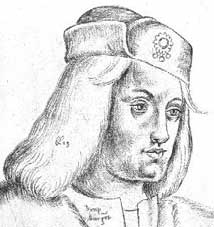
Perkin Warbeck - The Male Model Who Fought A Tudor King

* This is a quirky story from history that has long intrigued me, partly because the outlandish plot to usurp the first Tudor King of England was hatched in my home-town, the southern Irish port city of Cork. It's also the real reason why Cork is still called "The Rebel City", a title that has nothing to do (as most people think) with Michael Collins and the 20th century fight for Irish independence. In fact, the title is not so much about Michael Collins as Derek Zoolander.

"some dudes brainwashed Derek to off the prime minister of Micronesia!"


It's a strange one - the tale of a late medieval male model who suddenly found himself thrust into centre-stage in the European power-politics of the day. It's the story of a charismatic, foolish young man who found out there was more to life than being really, really, ridiculously good-looking.

Perkin - The Tudor Zoolander 
* In the autumn of 1491, a Flemish merchant's ship docked in the southern Irish port of Cork. The city had been welcoming trade from the continent for centuries and the small ship, loaded with fine silks, furs and other luxury goods, would not have excited much comment. 

On board was a Breton silk-merchant called Pierre Jean Meno and his young apprentice, the son of a poor but respectable burgess of Tournai called Jehan de Werbecque. The apprentice was 17-year-old Perkin Werbecque.


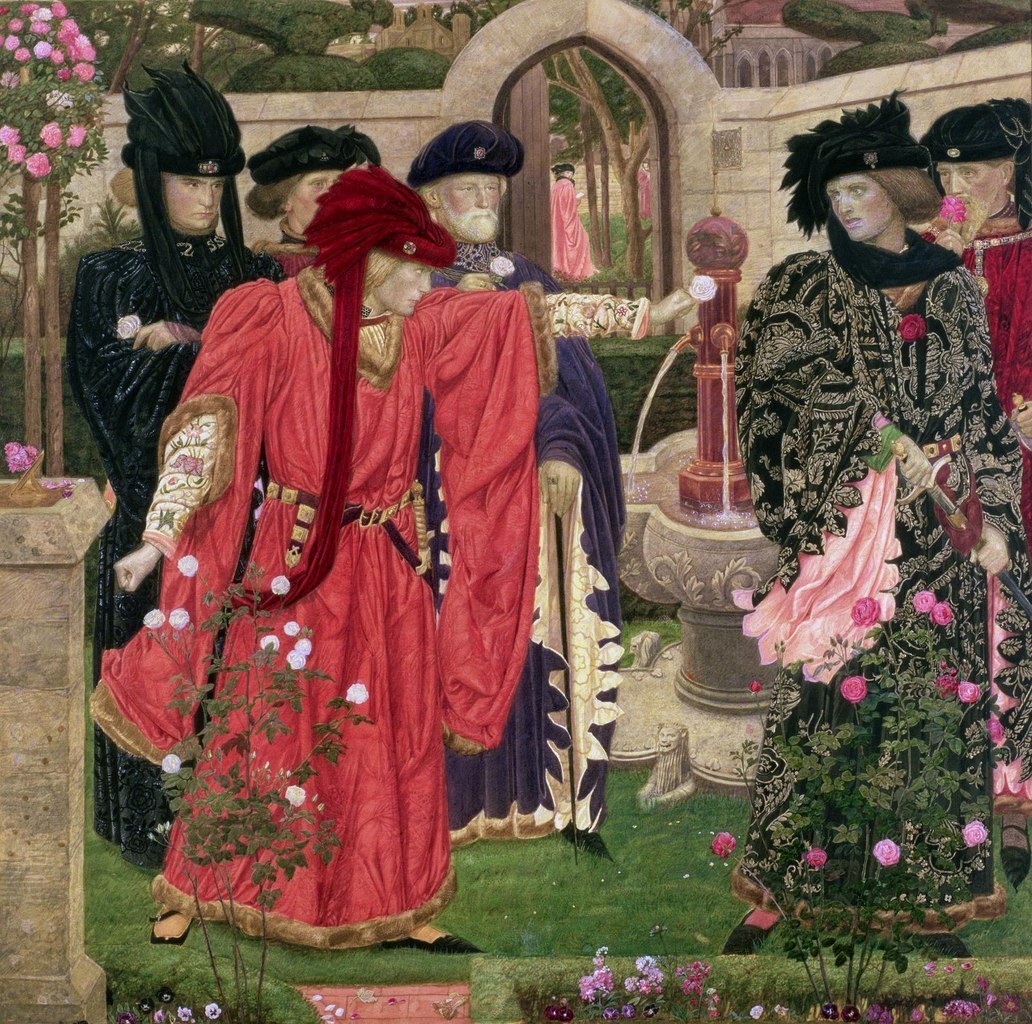
These were turbulent times in Ireland, Britain and beyond. Ireland was still a stronghold of the York family, who had been defeated by the Plantagenets in the recent, insanely complicated dynastic struggle known to us as the Wars of The Roses (My kingdom for a horse, and all that).


The Wars of The Roses - Florist Against Florist
The Yorkists still believed they could take back the crown from the usurper Henry VII (father of Henry VIII of...er...Wolf Hall fame). But they lacked a candidate to unite around, the York family men being prone to having large steel blades inserted into various parts of their bodies.

Edward & Richard - The Royal Brothers Who Disappeared In The Tower
Henry VII was the first Tudor monarch, having invaded from France and seized the throne from the Plantagenet King Richard III (whose body was recently found under a car-park in Leicester) who in turn had taken it from the 12-year-old Edward V, one of the two Princes In The Tower, who had disappeared while being "protected" by Richard in the Tower of London (try to keep up).

So! Confused times. And into this, or at least into the small port of Cork, many miles across the sea from London, walked the handsome young apprentice, Perkin Warbeck. 

His job, while in Cork, was to be a sort of Male Model. He would don his master's finest silk clothes, stroll about the town and basically act as a human mannequin, telling those who asked where they could find the merchant with the exquisite cloth. 

And Perkin was, by all accounts, a handsome and charismatic kid. So charismatic, that the rumour soon went around the city that this beautiful, finely dressed young man with a funny accent must be an aristocrat. In fact, as the whole of Cork was soon saying, he was really the Earl of Warwick, one of the many missing Yorkist noblemen with a claim to the Crown Of England, Wales and Ireland!

Sure, he didn't exactly speak English. But look at those clothes! That fine face and noble carriage! He HAD to be a nobleman!

As the tumult went up and the mob gathered, Perkin denied that he was the Earl. No, he was in fact....Richard, Duke of York, one of the disappeared "Princes In The Tower" and the one true King!

Historians have long argued how, exactly, Perkin pulled this one out of his silk-clad arse (although they tend to dress up the language a bit). Was he a foolish young man, who knew all of the stories about the tragic Princes which had scandalised Europe, and gotten a little carried away with all the attention? Or had he been sent by the French king to ferment trouble for the current King of England, whose grasp on the crown was shaky at best?

But whatever the reason - this was SENSATIONAL! The Duke of York, in Cork! The streets ran wild with Yorkist sentiment. 

Cork had some previous in the Pretender Game. Just a few years earlier they had welcomed another unlikely claimant to the Throne of England, a young man called Lambert Simnell, who had arrived in Cork, was proclaimed Earl Of Warwick (who apparently made more comebacks than Sinatra) and managed to lead a rebellion into England which was finally defeated in battle, but not before Henry VII had gotten quite the shock. 

For the vocal support of both Simnell and Warbeck, Cork would be dubbed a "Rebel City" by King Henry VII, a moniker that has stuck to this day. 

Having seen Simnell come a cropper, the people and city fathers of Cork were a little less hasty when it came to Warbeck. He was given a bit of a party and then sent on his way back to France with plenty of "Good luck to ye now, and if it all works out well with the whole Claiming the Crown thing, make sure to get back to us!". 

The French King Charles VIII did welcome Warbeck/Richard and - together with Margaret of Burgundy - backed his claim. Further headaches came for Henry VII when the Holy Roman Emperor Maximilian (the real Big Cheese) also recognised the good-looking guy in silk. 

It looked like serious trouble for Henry. But he was a smart operator with a very good spy network in Europe who informed him of two salient facts. Firstly, the support for Warbeck amongst his kingly rivals was luke-warm at best. And secondly, Emperor Max had money problems and his attention on Italy. 

Henry wisely bided his time. When Warbeck and his small band of supporters tried to invade England at Deal in 1485, it turned into a fiasco and Warbeck was forced to sail first to Ireland and then to Scotland to try and find a safe haven and regroup.

In August 1497, after more adventures and another failed attempt at invasion, he was persuaded to give himself up at an Abbey in England, where he had tried to claim sanctuary. 

Henry was remarkably lenient with the young man, keeping him at court so he could keep an eye on him. But after he tried to run away several times, the King's patience ran out and Perkin was tried and executed in London on November 23rd, 1499. He was 28.

At best, Perkin Warbeck was just the dupe of powerful men involved in the long-running dynastic squabbles of the era. They said he went to his death with dignity. And dressed in a simple white linen smock. 

**** hey, thanks for reading!***** 

Tuesday, 17 February 2015

Jesus Was A Crossmaker - The Sad Ballad of Judee Sill

* Back, way back, when people still bought CDs, I was in Tower Records in Dublin, passing a bit of time when I came across a double album on sale. It was a reissue - The Judee Sill Collection. I'd never heard the name (and the spelling was a bit strange) and the picture of the waif-like woman on the cover, wearing what looked like National Health Glasses, didn't promise a lot. But, curiosity piqued, I stumped up the five bucks and brought it home for a listen....


Judee Sill 
* It might be a bit unfair to call Judee Sill a forgotten singer-songwriter, as a small but fiercely devoted band of fans still keep the flame burning.

But Sill, who had a sad, strange life and recorded some beautiful, haunting, playful, inventive music through her tumultuous time, is not a name you hear very often these days.

Sill is often described as looking like a librarian. Her voice was quiet and fragile yet powerful. And her lyrics are often inscrutable, or at least Dylan-esque in their complexity and depths. The music was heavily influenced by Bach. The vocals were often layered and over-dubbed - her own voice, on top of itself several times. It's early 1970s, woman singer-songwriter, but very orchestral, complex and lush.

The clip down below - of her singing The Kiss - might remind you of other folk-influenced female singer-songwriters of the early '70s. But you can't say it's typical, not when you listen to something as upbeat and playful as perhaps her best known songs, like Jesus Was A Crossmaker or Crayon Angels.


Her voice is incredibly warm and affecting, quietly optimistic. Which is something given her struggles through life.

She was signed to the Asylum label in the early 1970s - the label that David Geffen would use to launch the careers of the greatest singer-songwriters of the era.

But Sill only recorded two albums (now considered lost classics) before addiction, mental illness and a terrible series of bad choices took their toll.

Sill was a chronic heroin addict from her late teens. And had a string of arrests, including several for prostitution and armed robberies of convenience stores in Ventura, California, before she was into her early twenties.

"I did heroin with gusto because I wanted to escape my torment and misery,' she told Rolling Stone in 1972 of her three-year addiction. 'But then I figured if could maintain that kind of habit that long, the willpower I'd need to kick it would be a cinch.'  

She did kick heroin - but that was only one of the many problems which threatened to derail her life and constantly thwarted her attempts to build a career.

Sill was bisexual - and also had a talent for finding the worst men possible (for her at least) going through a string of co-dependent, drug-addled relationships and marriages, all before she briefly tasted success as an Asylum recording artist.

Her childhood was pretty chaotic - her dad, Millford Sill was, variously, an importer of exotic animals for movie work, part-time bar owner and full-time drinker. Sill grew up in her father's bar, and when he died early in her life, her mother married an animator best known for working on Tom & Jerry cartoons. It was a chaotic, bohemian, substance-driven. Her father, brother and mother all died when she was still in her teens.


However, she kept a strong sense of faith and spirituality throughout her life - sometimes saying that she wrote songs that "were aimed at persuading Jesus to give people a break".

By the time she died from drug abuse in 1979, she had long been forgotten. Her once intense relationship with David Geffen broken, which left her very bitter about the music industry.

Judee Sill could have been a Joni Mitchell, today she is not even a Nick Drake - another fragile singer-songwriter of the era who died tragically young but is today revered.

Few people really remember Judee Sill, which is a great shame, as she had a kind of genius.

I would heartily recommend checking out her two released albums and the collection of recorded but not released in her lifetime songs.


Also - there's a very good BBC4 radio doc about her - which you can listen to by clicking on above.

*** THANKS FOR READING****

Sunday, 8 February 2015

Danno O'Mahony - Champion of The World

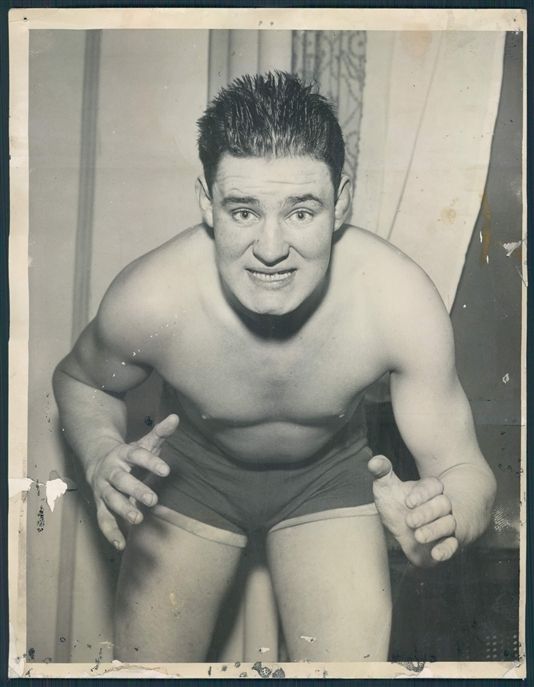
Some Man - Danno O'Mahoney

* For a time in the mid-1930s, Danno O'Mahony was arguably the most famous Irishman in the world. And he was certainly one of the few West Cork men who made his living in tights.

Danno had a vast army of admirers. And a legion of sworn enemies. Their black ranks included Ed "Strangler" Lewis, Steve "Crusher" Casey, Bronko "The Red Menace" Nagurski, Chief Little Wolf and The Infamous Flying Dusek Brothers.

All had sworn to defeat Danno. Some reckoned they did. But while the big man was often floored, Danno always rose from the canvas, puffed out his massive chest, danced forward and executed his killer move - the Irish Whip.

He was one of the biggest stars of the Golden Age of Pro-Wrestling - a time when Grunt n'Grapple was as big as boxing and taken (almost) as seriously. It was the great American Blue-Collar past-time - and Danno, the handsome farm-boy from West Cork - was one of it's biggest names.

On April 26, 1935, just months after Danno had swapped an Irish army camp for the life of a sports-star in the US, he faced Ed "Strangler" Lewis at the Boston Garden in front of 20,000 wildly cheering fans. Danno won the first fall after twenty minutes of grunting, groaning and grappling with his signature Irish Whip.

But Strangler, in a red rage, rose and threw Danno from the ring. Ten Boston-Irish cops tried to stop Danno, blood streaming from a cut above his eyes, from getting back in to murder the Strangler.

The Irishman hurled them aside, leapt over the ropes and executed a fall so hard, the Strangler was laid out unconscious on the canvas. Danno was pro-Wrestling's World Heavyweight Champ.

The Boston Globe called it a "thrilling match with a great climax".

Danno sailed back to his native shore, arriving in Cobh on a transatlantic liner to a huge reception, caught on newsreel and shown around the world.


Danno was born on a farm outside the West Cork village of Ballydehob in September, 1912. His father, Big Dan, was (as the name might suggest) a mountain of a man, 6'5'' and almost as wide, a famous sportsman in the locality.

Young Danno left school at 13, worked on the family farm and then joined the Irish Army. He quickly became a star athlete, setting several national records in strength events, including an Army record for the hammer-throw that wouldn't be broken until 1990.

Professional wrestling was a huge sport at the time, in the US but also in Europe. When the legendary promoter Paul Bowser decided he needed a new star - and an Irish one to get in the huge, East Coast Irish-American crowds - he approached the famous Irish Olympian (and 1928 Hammer Gold Medallist) Pat O'Callaghan with an offer. O'Callaghan, a qualified doctor, turned him down. But he did recommend a fellow Corkman, a private in the Irish Army who could "fit the bill", the young giant Danno.

Bowser used his connections with Boston Irish politicians to get Danno "excused" from the Irish Army (it's said the Boston Police chief wrote a personal letter to the Irish Minister for Defence, Frank Aitken) and the Cork kid was soon on a boat heading for London, to actually learn how to wrestle with one of Bowser's English contacts..


When Bowser finally met with Danno in New York, he realised that in the huge, handsome Irishman with the charismatic smile, he had hit gold.

On January 2, 1935, after a rough Atlantic crossing and a smoother ride from New York to Boston in a private plane, the kid who had recently been an Irish Army private on eight quid a week signed a five year, pro-Wrestling contract said to be worth $100,000 dollars.

Danno In Scary Pose 
The West Cork boy was living in one of Boston's finest hotels, eating steaks and training every day, ready for his big professional debut in the Boston Garden.

Pro-wrestling was then, as it is now, "sport entertainment".Wrestlers had clearly defined personae, they were mostly either Heroes or Heels, they represented immigrant groups or crude racial stereotypes. Danno O'Mahoney (the promoters added an "e" to his surname) would be a champion of the blue-collar East Coast Irish, the Gorgeous Gael, the kind of wrestler you could take home to meet your mother.


He was wildly successful over a short period of time, regularly wrestling in front of crowds of 20,000 or more. It was the first Golden Age of Pro Wrestling, when the biggest stars were household names across Europe and the US and newsreel cameras brought the latest big bouts into the cinemas.

One of his first bouts, against the hated "Heel" Ernie Dusek at the Boston Garden on Jan 5 1935 drew a crowd of 20,000. The local papers said "at least of 14,000 of these were screaming Irishmen, out to support their boy". Danno seemed to freeze at first, hardly surprising given that a few months earlier he had been a private on a remote Irish Army camp who had never really wrestled in his life.

However, after a few hesitant rounds, Danno gave the Irish crowd what they wanted - using his patented "finishing move" the Irish Whip. This move, still seen in pro-wrestling today, involves catching your opponent by his outstretched arm and using his own momentum to "whip" him into the ropes, ready to be clotheslined on the rebound.

Ernie Dusek got laid out. Which was too much for his cornerman and brother Rudy, who jumped into the ring and attacked Danno. Then Ernie got off the canvass and joined his brother. Danno responded by "punching everything that moved" including the ref (Sam Smith) and the Boston police who were usually on good money from the promoters and could always be guaranteed to join in the fun/mayhem.

"Danno threw punches at the police, as the crowd roared their approval" was how one local paper reported it. Danno was eventually crowned champ and the huge crowd went home happy. It was Friday night entertainment, they got to see the giant Irish lad lay into the cops and beat the Duseks.  Boston had a new hero.

Danno had a brief but glittering career, was World Champion several times - but in pro-Wrestling, such titles were always contested by rival organisations and the behind the scenes strokes and fixing meant that careers could be made and destroyed very quickly.

Perhaps his greatest occasion was a title unification fight with rival Ed Don George on July 30th, 1935, a match that drew over 40,000 fans (including Massachusetts Gov James M Curley) to the Braves Field Baseball Park. The gate was reported to be $60,000 dollars.

However, the bout had a very poor finish, the crowd were unhappy and the press started to turn on the promoters who were so obviously fixing fights and carving out monopolies.

Danno also had visa problems which affected his career. He married, moved to Los Angeles, opened a restaurant and then joined the US Army during WWII.

After the war, he decided to move back to Ireland and his native West Cork for good. But in 1950, at the age of just 38, and only a couple of months after returning home, Danno O'Mahony died from injuries sustained in a car crash.

He was hugely, briefly famous across the US and Ireland. Today, he is still remembered in his home town, where there is a statue of him standing at the crossroads as you drive in from the Cork City side.

From West Cork fields to performing in front of tens of thousands across the US, Danno O'Mahony had pro-Wrestling to thank for a life less ordinary.

**** Thanks for Reading****


Thursday, 29 January 2015

The Cold War Bulgarian Umbrella Killers Of London


* The newly opened public enquiry into the horrible killing of Russian dissident Alexander Litvienko in London is already throwing up plenty of details that will be embarrassing to the Kremlin in general and Vladimir Putin in particular. Assuming that Vladimir Putin can actually experience embarrassment.

But Litvienko was not the first Eastern dissident to be assassinated in London. And one of the previous cases has eerie similarities with the polonium poisoning case.

So read on.......


Georgi Markov
     * Two secret agents track a man through the streets of busy streets London. They have followed him in and out of cafés, on the Underground and along pavements, trying to engineer a chance encounter. The Eastern European spies have already tried at least once to get close enough to administer a deadly poison to their target. This time, in one of the busiest spots in central London, they are successful. The poison is delivered. The target - a writer and journalist who has been deeply critical of the regime in his native country - has barely noticed anything. But soon he will tell his colleagues and family about a sudden rash, a rapidly developing illness. He is taken to hospital where doctors are mystified as to the cause of his rapid and unstoppable decline. He insists he has been poisoned. He raves about KGB assassins sent by political masters in the East, his former homeland.  

Within four days he is dead. 

If you have been following the case of Alexander Litvienko, this scenario will sound very familiar. Exotic poison, assassins from behind what we once called the Iron curtain. A brazen political killing on the streets of London.

But this is actually the story of Bulgarian writer and dissident Georgi Markov, killed on the instructions of a communist secret police in London in September 1978. I remember reading about it when the real story started to emerge in the early '80s and the impression that it made on me. This was a fictional spy thriller come to life. They had killed him with - of all things - a poison tipped umbrella.

Markov had been a writer, a dissident who moved to London to escape persecution in his native Bulgaria and worked for the BBC and (more infuriatingly for the Communists) the US-Funded Radio Free Europe, a network of polyglot stations, broadcasting directly into the Communist Bloc with news, political views and music that the regimes there did not want their people to hear.

Markov In London

On September 7th in '78, Markov was walking across Waterloo Bridge in London, going to catch a bus to his job at the BBC. As he stood at the bus stop, he felt a sharp sting on the back of his right thigh, as if he had been bitten by a particularly big bug. 

He quickly looked around and spotted a man picking up an umbrella and hurrying away to grab a taxi.

Markov was a little shook but continued on to the BBC, where he told colleagues about what had just happened to him and showed them a little red raised bruise on his thigh.

That evening he developed a fever. Shortly after he was rushed to hospital - where doctors were unable to establish the cause of his sudden and rapid deterioration. Markov insisted he had been poisoned by the man with the umbrella. Four days later he was dead, aged 49.

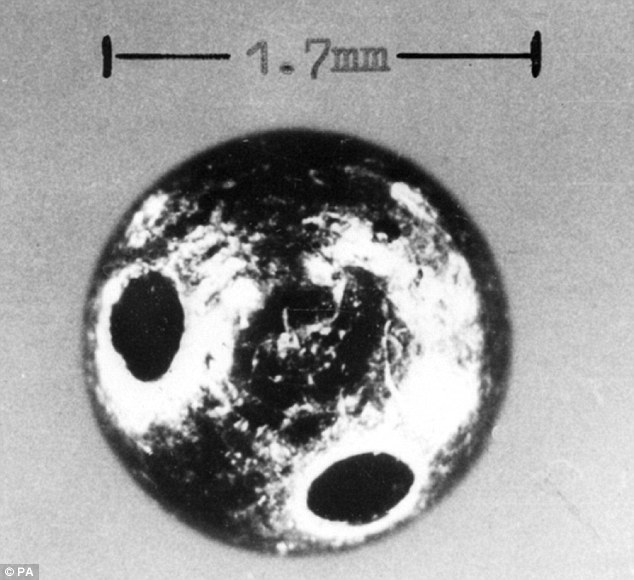
It was established that the cause of death was a metal pellet the size of a pin-head, a hollow ball, filled with the deadly poison Ricin. Even if the doctors had known the nature of the poison, they could not have treated him. There was no known anti-dote for it at the time.

Investigators later deduced that the pellet had been fired from the tip of an umbrella, using a pneumatic system similar to an air-rifle.

Diagram Of Suspected Umbrella Gun


The police and secret-service agents investigating the death then discovered that just ten days before the fatal attack on Markov, the exact same method - a poison-tipped umbrella - had been used in an ultimately unsuccessful attempt on another Bulgarian dissident on the Paris Metro.

The Actual Pellet Taken From Markov's Leg


It has long been believed that the Bulgarian secret police, backed by the KGB, used a Danish man of Italian heritage - Francesco Gullino - to carry out the actual attack on Markov. Gullino was said to be an art dealer turned drug smuggler who had been captured by the Bulgarian police and given the simple choice - work for us in the West or spend the rest of your live in a Bulgarian jail.

Gullino - codenamed "Picadilly" by the British secret service - has never been apprehended and is believed to be still travelling, under several false identities in Europe to this day.

There are many strange similarities between the case of Markov and that of Litvienko, poisoned with radioactive polonium in a London coffee shop.

The family of the Russian must hope that they get a better shot at final justice than those who loved Markov ever did.

****THANKS FOR READING*****


Monday, 19 January 2015

Captain Jack White - The British War Hero Turned Anarchist Who Drilled The Citizens Army

* Regular readers may, by now, be familiar with my obsession with the lesser told, quirkier stories from history in general and Irish history in particular.

With the Centenary of the Easter Rising on the horizon, we are going to hear a lot of familiar stories, the headline names of 1916 and lots about what that armed revolution means to modern Ireland (not a hell of a lot, in my humble opinion. Whatever those men had in mind for this island, what we have now comes nowhere close. It was just another chapter, now long past.)

But I'm drawn to the figures and stories on the periphery of the Rising, The ones mostly forgotten now, or written out almost from the start because they didn't fit the conventional narrative...

And so I've long be interested in the story of Captain Jack White. A hero of British imperialism, turned radical socialist, then anarchist, a man who lent his life to a series of lost causes. A man who was, in his own word, a misfit.

So here follows a brief history of a fascinating man......


Captain James Robert "Jack" White  
* A handsome man with an unmistakeably military bearing. Dressed in civvies but holding a rifle. Captain James Robert White, always known as Jack, is largely forgotten in Ireland, Britain and Spain now. But for a long while, he was at the centre of great events.

Through his life, he believed in socialism and the collective cause and destiny of the working classes. And he believed in their right to organise, arm, drill and fight.

It was Jack who organised the Irish Citizen Army, after seeing the strikers in the 1913 lockout - the bitter struggle between the unions and the employers - getting knocked about by the police and strike-breakers.

White - who by then had left his official soldiering days with the British Army far behind him - saw the need for a disciplined force, a Citizen Army that could, as he said, "put manners on the police".

White was the true born son of the Empire, He was born in 1879 on the family estate in Co Antrim in the North of Ireland, the only child of a full British Field Marshal - Sir George Stuart White VC, GCB, OM, GCMG, and so on. Sir George had won Britain's highest military honour, the Victoria Cross, fighting the hill tribes in Afghanistan, in the year his son was born.

Jack was educated at Winchester (from which he was expelled) and the Royal Military College at Sandhurst. He began his fighting career aged just 18 with the Gordon Highlanders fighting the Boers. And he was awarded the Distinguished Service Order for an act of great bravery and initiative.

However, it was also in South Africa, during that bitter war, that Jack first showed signs on a very un-imperialistic streak. During one furious battle (as he later recalled), a 17-year-old soldier in White's section lost his nerve and stayed shivering in his trench. A senior officer called to the young Lieutenant White; "Shoot him!". When Jack did not move, the officer moved towards the youth with his own side-arm out. Jack is said to have drawn his gun, covered the officer and coolly told him; "Do it - and I will shoot you".

There was further some service with the army in India, but it seemed Jack White and the British army were destined to have a parting of the ways.

He returned to his native Ireland and became interested in radical politics, then a huge draw to many young members of the aristocracy with questions. He dropped out of society, travelled to Canada to work as a lumberjack, taught in various schools and joined a radical commune influenced by the writings of Tolstoy (Jack actually wrote letters to HG Welles and Tolstoy to explain his new course in life, Tolstoy is said to have written back approvingly).

The commune, in the English countryside, also welcomed practitioners of Free Love. It was pretty radical stuff for the son of a full British Field Marshal in the 1900s.

It was this romantic search for something new, something better, that eventually brought him to Dublin, where he met with the Scottish born, Irish socialist leader James Connolly. The two men, who could hardly have been from more different backgrounds, struck up what became a very strong and enduring friendship.

White got caught up in the labour battles around the time of the 1913 Lock-out. He saw the ranks of the union men broken up by police batons and decided it was time for them to fight back.

Captain Jack White (carrying the flag) with the Irish Citizen Army

White organised, drilled and commanded the Irish Citizen Army. Which would go on to fight in 1916.

White did not fight in 1916. He had been organising a Volunteers brigade in Derry, but was very disillusioned by the sectarian, anti-Protestant views he encountered there. He also managed to fall out with his fellow protestants who put sectarian beliefs before the unity of working people. It was to be a motif throughout his life. It seems that Jack White was always on the search for purity of belief and deed. And he would always be disappointed in his fellow men. Those who put nationalism, religion, class prejudice, a thirst for power or control, above what he saw were the simple tenants of socialism. When he appealed to the Irish Volunteers for unity with their fellow protestant workers, they often accused of him "looking out for his own" and questioned his commitment to the glorious cause of Irish freedom.

But White could be just as difficult with his fellow Protestants he believed that true Protestantism should be behind those who wanted a better, fairer world for all. Not just Orangemen and the sons of land-owning British Generals.

To the Protestants, he was always a "Shinner". To the Republicans, an Orangeman, a toff, ex-British Army and the son of a General. Not for nothing did White call his autobiography, written in later life when disillusion had largely taken hold; "Misfit".

When Connolly (his great friend) was sentenced to death after the Rising – White tried - in vain - to organise the Miners of Wales to go on strike to save his life. 

He later travelled further to the left, joined with Sylvia Pankhurst’s Workers Socialist Federation in England, organised a communist republican group in Ireland in the 30s before joining the anarchists in Spain during the civil war.

Jack White volunteered for the Red Cross in Spain and helped organise the Connolly Column and was thrilled to see Irish protestants and Catholics, all socialists and communists, fighting together for the people. He also distributed handguns to the women of towns and villages around Madrid and drilled them in how to protect themselves. White may have been high-minded in his politics but he was always a practical man. When a fascist is advancing on you, better to have bullets over banners.

Once again, White eventually became disillusioned with the in-fighting and betrayals, becoming avowedly anti-Stalinist and leaning more towards the Anarchists, the only keepers of the pure flame. In this, he was following a similar path to George Orwell, another ex-Imperial policeman. 

He returned to the family home in Co Antrim, shortly before the outbreak of the second world war. There was a brief reappearance in Public life when he tried to stand as a "Republican Socialist" candidate for Antrim in the 1945 general election, but by then those who knew him at all regarded him as little better than an eccentric, rowing pointlessly against the tide of the times.

Jack White died of cancer in a Belfast nursing home in 1946. His family, embarrassed by his revolutionary past, burnt almost all his papers and writings shortly after his death. 

He was a remnant of a strange, romantic, heady time, when many upper-class English men and women, bred to Empire, decided on a radically different course and fought for universal socialism and the rights of every man.

In his beliefs, he was a radical, a puritan, a believer in the essential brotherhood of men and their desire for a just and equal world, He believed, passionately, that you only had to give people the means to fight and the cause to fight for and they would follow.

He was destined to be disappointed. In the end, disowned and hated by Republican catholic and protestant unionist, Jack White was, as his own epitaph said, the eternal misfit.

*** Thanks for Reading! And Don't Forget to Share If You Enjoyed - Tip Your Blogger***** 


Tuesday, 13 January 2015

Hot Potato! Alan Partridge, Charlie Hebdo and C4's Modest Proposal For A Famine-Com

* This Saturday in London, a group of protesters intend to march to the HQ of broadcasters Channel 4 to voice their anger over a proposed sit-com - set around the Irish famine.

The march is being organised by the Campaign for the Rights and Actions of Irish Communities - the rather ironically acronymed CRAIC.

The protest was organised before the Charlie Hebdo outrage in Paris. And it may seem crass to draw comparisons. But you might think it's a little strange that as the world shouts for  freedom of expression and artistic licence to take on even the most controversial subjects and issues, a fair proportion of Irish people are vehemently opposed to a comedy script that hasn't even been fully written yet.

It's not as if humorists haven't worked with subjects like millions of starving Irish people or the holocaust before. 

Irish satirist Jonathan Swift once made a “modest proposal” that the starving Irish could ease the burden by selling their children as food for rich Lords and Ladies. He was joking, of course.
Auld Swifty - He Also Did Fart Jokes

Jewish comedians such as Mel Brooks, Charlie Chaplin and Joan Rivers satirised the Nazis. And the late Rivers got into serious trouble in 2013 by observing of the German supermodel Heidi Klum; “The last time a German looked this hot was when they were pushing Jews into the ovens.”
Answering the outrage generated by her Holocaust joke, Rivers said: “My husband lost the majority of his family at Auschwitz, and I can assure you that I have always made it a point to remind people of the Holocaust through humour.”
Der Furher Was A Wunnerful Dancer! 

Monty Python were accused of sacrilege because of “The Life Of Brian” while the Blackadder team mined comedy gold from the horror of WWI trenches.

Comedians and satirists have always played with fire when it comes to grim historical events. But it could be argued that the best, like Swift, have used humour as a weapon against evil. As well as making us laugh. 
Anyhow!  I talked to Irish comedian, satirist and impressionist Mario Rosenstock, and Professor Gary Murphy about this, ahem, hot potato. 


Knowing Me, Knowing Potato Blight

* The Great Famine!  It’s no laughing matter. Unless you are Channel 4 or Alan Partridge.

In one classic, 1997 episode of the BBC comedy I’m Alan Partridge, the hapless TV presenter sat down with two Irish TV executives, played by Fr Ted writers Arthur Mathews and Graham Linehan.

Alan blundered into the subject of the Famine, asking a clearly uncomfortable Linehan (playing TV exec Aidan Walsh); “So, how many people were killed in the Irish famine?”

The Irishman replies; “Two million. And another two million had to leave the country”.

Patridge observes; “Right. It was just the potatoes that were affected? At the end of the day, you will pay the price if you are a fussy eater. If they could afford to emigrate, then they could afford to eat in a modest restaurant”.

If you thought that joke was in desperately poor taste, you may be one of many thousands who signed an online petition this week to demand that Channel 4 drops tentative plans for a sitcom set during the Famine.

Irish comedy writer Hugh Travers has been commissioned by the British broadcaster to write a pilot script for a “black comedy”, working title Hunger, set during the period around Black ’47.

It is to be produced by Deadpan Pictures, a spin-off of the Wicklow-based production company Grand Pictures, the people behind hit comedy Moone Boy.

“This is in the development process and is not currently planned to air,” said a C4 spokeswoman. “It’s not unusual for sitcoms to exist against backdrops that are full of adversity and hardship.”
Hugh Travers, best known for the RTE radio comedy-drama Lambo (a fictionalised account of the moment the late Gerry Ryan confessed to killing a lamb on The Late Late Show) told one newspaper about his thought process.
“Why the famine? Well, they say ‘comedy equals tragedy plus time’. I don’t want to do anything that denies the suffering that people went through, but Ireland has always been good at black humour”.
Travers may be shocked by the furore generated by his development script.
But another Irish comedian and comedy writer, Mario Rosentock, believes one factor in the outrage generated is social-media in general and Twitter in particular.
“Quite clearly, people are only too ready to jump on the outrage bandwagon,” says Mario.
“They can use this 140-character outlet to make a name for themselves, to get noticed. Twitter is like going into a bar and shouting at the top of your voice until everybody shuts up. And the best way to do this is to be rude or outraged about somebody, some TV show or whatever”.
Mario Rosenstock as Himself

The radio and TV comic says he wants to wait and see how the script turns out but he does not believe that the Famine should be off-limits for comedy.
“With a subject like the famine, the tone is going to be very important, it’s the overriding factor in any comedy like this,” says Mario.
“You look at shows like Blackadder, set in the horror of World War One, and they got it right, even up to that ending, where they went over the top, and suddenly it’s very powerful, it’s not about comedy anymore”.
“And just who is doing the jokes is also a very important factor. It kind comes back to the debate about how black comedians can use the N-word, but white comedians cannot.
“It’s largely because they are saying it about themselves.
“The fact that it’s an Irish writer, an Irish production company, and not English writers and producers doing this, I think that allows them, if that’s the right word, to at least look at the subject.
“In this case, the receivers of the injustice, some people would argue the genocide, are the ones who are writing something funny about it, or attempting to see the funny side of it.”
DCU Professor of Politics Gary Murphy believes that, on a basic level, no area of Irish (or wider) history should be off-limits for satire or comedy.
“It’s part of the human condition. We have been through all sorts of trauma, from famine times, a bitter, terrible civil war, right up through the troubles.
“And if we can’t occasionally make fun of our history, this human condition, well what’s the point of it all, really?”
“It’s also a dangerous road to go down. Once you start putting events off-limits, where do you stop? Do you not lampoon the Troubles, or the War of Independence?”
“It’s our story. And if comedy should do anything, it should enlighten that story. These terrible events should be up for discussion in all forms. And comedy is as much a form of political expression as any other”.   
Professor Murphy believes some of the negative reaction to the Channel 4 project comes from professional historians and commentators.
“We can get too po-faced about our history, saying we can only talk about these events in dry history books or serious commentary. It inhibits free speech and imagination.”
The academic believes that we may also be doing a disservice to the people who actually lived and suffered through the famine.
“We can only assume that people then had a sense of humour, not withstanding the unbelievably grim conditions, that’s just part of the human condition. And this idea that only historians can feel their pain, or because it was so terrible - and you can make the strong argument that the British Government just let the Irish to rot - that we can only talk about it in the most serious tones, well I find that very limiting.”
But should any subjects be off-limits for comedians? Mario Rosenstock says it’s an issue that he wrestles with and gives the example of Scottish stand-up Frankie Boyle’s notorious routine about the disabled son of glamour model Jordan.
“I don’t understand how Frankie Boyle, a man of his intelligence, needs to make jokes about Jordan’s disabled son. Yes, what he is doing there is showing us that he can do it, that it’s freedom of speech.
“But you can’t honestly say it’s funny. Nobody with a heart can say it’s funny. As a sentient human being you can’t go and laugh at that”.
******Hey! Thanks for reading!******