Friday, 11 April 2014

Gram Parsons & Thousand Dollar Wedding - A Strange, Beautiful Song.


                                            Stand By Your Gram 


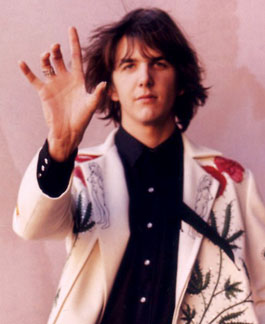
Gram Parsons - In Trademark Nudie Suit


* Back before the internet and on-demand music everywhere, a friend turned me on to Gram Parsons - the Southern Boy who kinda invented Country Rock, taking a traditional music, mixing it with a bit of Southern Gothic (and his own strange family history gave him plenty of material there) and a bit of Rock and Pop to produce something new and beautiful. As the official website dedicated to his memory points out (with justification) Parsons is probably up there with the likes of Elvis, Dylan and The Beatles in terms of his influence, which you can hear in any pop or rock song that has a country twang. He did "straight" country - such as his masterful version of The Streets Of Baltimore - and he did rocked up country. And beautiful ballads such as Hickory Wind.

He was gifted, a dreamer, tragic, and weirdly elusive and unknowable, no two photographs of Gram quite look the same and he didn't really write or sing songs about himself, it was more universal themes of place and feeling. With his Georgia, Southern Gothic background and his poetic style, he's as if Tennessee Williams went into music instead of writing stories.

You can read a good telling of the Parsons Story on the best website dedicated to him, here; The Story of Gram Parsons - and it is a story well worth reading - from his strange childhood, hanging out and influencing The Rolling Stones (in the process proving that no man alive should try to keep pace with Keith Richards when it comes to pharmaceuticals) to his tragic death.

But mostly it's about the music. And I always come back to Thousand Dollar Wedding - an incredible short story in soaring song. The story seems to be about a wedding that should - but didn't take place. You can almost imagine the groom and Gram as best man, sitting in a smoky dive bar somewhere, still in their suits and sipping whiskey as they sing this sad one. But what happened? Who left who at the alter? All we know is, it's been a bad, bad day.


The lines: "I hate to tell you how he acted when the news arrived 
He took some friends out drinking and It's lucky they survived..." remind me of another break-up at another time and how men in particular react to romantic disaster.


A Young Gram 


Gram played with The Byrds and was a major influence on the classic Sweetheart of the Rodeo album - another of my all time faves along with his own Grievous Angel. 

But where you should start is Thousand Dollar Wedding. Listen to Gram and Emmylou Harris duet on a strange tale of a wedding that didn't happen. The soaring middle part of the song, after the first part of the duet, is extraordinary. It's just a beautiful, haunting song. 


It was released on the Grievous Angel album four months after his death in 1973.

And I hope I haven't oversold this - you can listen to it here - with the lyrics below. 


Also - a solo version, with just Gram on the piano and voice - Here


The lyrics - 


It was a $1000 wedding supposed to be held the other day 
And with all the invitations sent
The young bride went away
When the groom saw people passing notes
Not unusual, he might say
But where are the flowers for my baby
I'd even like to see her mean old mama
And why ain't there a funeral, if you're gonna act that way
I hate to tell you how he acted when the news arrived
He took some friends out drinking and
It's lucky they survived
Well, he told them everything there was to tell there along the way
And he felt so bad when he saw the traces
Of old lies still on their faces
So why don't someone here just spike his drink
Why don't you do him in some old way
Supposed to be a funeral
It's been a bad, bad day
The Reverend Dr. William Grace
Was talking to the crowd
All about the sweet child's holy face and
The saints who sung out loud
And he swore the fiercest beasts
Could all be put to sleep the same silly way
And where are the flowers for the girl
She only knew she loved the world
And why ain't there one lonely horn and one sad note to play
Supposed to be a funeral
It's been a bad, bad day
Supposed to be a funeral
It's been a bad, bad day.

* Thanks for reading. 

Sunday, 6 April 2014

The Whiskey Cannibal & The Heart of Darkness

* This is a cut-down of a chapter from my last book - Murder, Mutiny & Mayhem - The Blackest Hearted Villains From Irish History - it's also an incredible story that had not really been told (in full form at least) until I came across it. I would love to go to the Congo some day to retrace the steps of Jameson & The Last Expedition. It's on the to-do list. If you want the full story, check out the book - it's O'Brien Press available on Kindle, Amazon etc, most good bookstores & some mediocre ones. ENJOY! 


The Whiskey Cannibal - James Sligo Jameson and the Heart of Darkness.

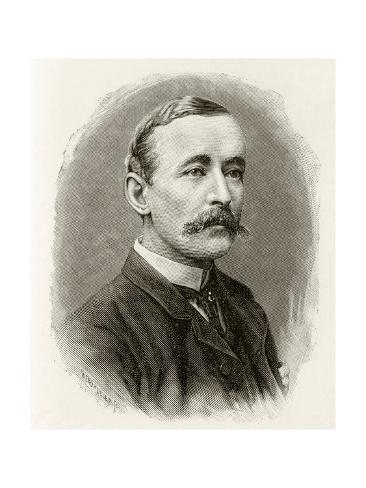
James Sligo Jameson


In a jungle clearing in an unmapped region of the Congo River basin, an Irish gentleman discusses the rites and rituals of cannibalism with a slave trader. James ‘Sligo’ Jameson, scion of the famous whiskey-distilling family and one of the great naturalists of the late-nineteenth-century ‘age of exploration’, is far from home, fever-wracked and travelling under the dubious protection of the notorious Arab slave master Tippu Tib.

Jameson is a well bred, well-connected Victorian gentleman-explorer and naturalist, famed for his sketches of butterflies and birds, made during previous travels through Southern Africa, Borneo and the Rocky Mountains of the North America continent. An experienced traveller, he had volunteered to face danger in the previously impenetrable Ituri forest of the Congo basin. He has been fascinated with science and nature since he began collecting birds’ eggs around the family home at Glen Lodge, in Co. Sligo as a young boy. But in April 1888, he is hopelessly lost, cut adrift from the main column, abandoned by the legendary explorer who recruited him to take part in the greatest expedition of the age, Henry Morton Stanley.

Struggling along a slaver’s trail towards the village of Kasongo, a reluctant, desperate guest of Tippu Tib – independent Arab warlord and trader – and his private army, Jameson has, between
bouts of fever, been nursing a dark and growing fascination with stories of cannibalism. The only other white officer in the rag-tag column, British army Major Edmund Musgrave Barttelot, is going slowly mad. Barttelot has already kicked one camp boy to death and killed another with three hundred lashes from a rhino-hide bullwhip. He will shortly be shot dead by a local gang-master after physically attacking the man's wife.

Bivouacked overnight in a jungle clearing, Jameson once again pesters his host about the ‘travellers' tales’ he has heard concerning the local tribes and the butchery and eating of slaves. This time, perhaps exasperated by his guest's obsession with cannibalism, Tippu Tib offers a practical demonstration.

Henry Morton Stanley - Hat Enthusiast
What happened next would be at the centre of the final, gruesome chapter of the story of the heroic age of European exploration in Africa and its enduring legacy of brutal conquest, instability and exploitation. It would pit Henry Morton Stanley, the journalist and adventurer who found fame as ‘the man who found Dr Livingston’ against the Jameson family and become one of the great, international scandals of the late Victorian era.


Allegations and counter allegations made by Stanley, survivors of the expedition, the Jameson family and British colonial officials would be made via letters and editorials in the most influential newspapers of Dublin, London and New York. Stanley and his allies would accuse Jameson of the most horrible crime, buying a young slave girl for the ‘sole purpose of having her murdered, so that a cannibalistic scene might be furnished for his sketch book’. The Jameson family would accuse Stanley and others of fabricating horror stories and attacking the reputation of an honourable man who could not defend himself. Stanley’s expedition had become a three-year, continent-crossing trek of slaughter, savagery and disease, costing thousands of lives, and attracting fierce public criticism. The great man would be accused of finding a convenient fall-guy in the Anglo-Irish naturalist.

What would never be in question was the fact that a father and husband, who had dreamed of exploring Africa as a young boy, poring over maps in his grandmother's house in Co. Sligo, met a terrible, squalid end in a disease-ridden camp far from home.

And what sealed his fate as a "Consort of Cannibals" was his own, incredible journal, carried out of the jungle by one of the last survivors. It clearly detailed his own involvement in dark rites and condemed him in his own words.

The scandal would drag on for years and the Jameson name, for a time, became synonymous not with whiskey, but with cannibalism; there is even strong evidence that James ‘Sligo’ Jameson was the model for Joseph Conrad’s Mr Kurtz in his classic story of civilisation, madness and the Congo, Heart of Darkness.

Conrad, the Polish-seafarer-turned-British-novelist had only recently returned from his time as a river boat captain in the Congo and the press was full of accounts of the appalling behaviour of Stanley’s officers on his last, disastrous expedition. Conrad’s biographer Chris Fletcher cites the infamous, real-life, tale of the Irish gentleman naturalist who consorted with cannibals and notes the great novelist described Mr Kurtz starting out as ‘an emissary of pity, and science, and progress’. Conrad has Kurtz ‘presiding at certain midnight dances ending up with unspeakable rites, which ... were offered up to him – do you understand? – to Mr Kurtz himself.’ These eerily mirror the charges laid against James Sligo Jameson.

Further parallels may be seen when Conrad writes of Kurtz’s widow and her inability to deal with the truth of her late husband’s madness. However, Conrad, Ethel Jameson and the readers of the Victorian press might never have learned the true story of James Sligo Jameson if it wasn’t for a few survivors, including a Roscommon-born doctor and adventurer, who miraculously completed a a cross-continental trek of almost unimaginable horror and difficulty.

That doctor was Thomas Heazle Parke, who joined the expedition in early 1887 after a chance meeting with Stanley at Cairo, where he was serving as a military surgeon.

A Rather Fanciful Illustration of Parke
Parke would play a significant role in the expedition and the subsequent controversy. By any measure, he was a remarkable figure. He took part in the Gordon Relief Column into Sudan. He spent almost three years with Stanley, became the first Irishman to cross the continent of Africa (on foot) and if any member of the expedition could have been considered a hero, it was the modest, resolute and kindly army surgeon who spent his childhood in Leitrim. There is a statue of Parke outside the Natural History Museum in Dublin.


The stories of Jameson and Parke, two Irishmen far from home, and the true motives for what has become known as The Last Expedition, reveal the darkness, greed and power-plays at the heart of the great age of exploration in Africa.

That the gentle, butterfly-obsessed grandson of a Dublin distiller should have been there at all is one of those strange quirks of history, a forgotten chapter in the story of an Irish family name known throughout the world. It involves ruthless newspaper magnates in New York and London, a rapacious Belgian king, private African armies, renegades, slave traders, corrupt politicians and a famous explorer with a secret past.

And it begins with the one of the most dramatic convulsions of the High Victorian age, the killing of Major-General Charles George Gordon at Khartoum in January, 1885.

The death of Gordon, and thousands of soldiers and civilians, at the hands of a radical Islamic general and self-styled messiah known as the “Mad Mahdi” in the Sudan unleashed a torrent of emotion back in London.

It brought down the Government of William Gladstone and led to the imperialists and the Jingoist press calling for a new effort to plant the flag in the heart of Africa.

They turned to the great explorer, Stanley, not knowing that he had already negotiated a secret side-deal with the King of Belguim, who owned and operated a vast, private slave-empire across the Congo region and wanted more.

Stanley and his men, including Sligo Jameson and the Leitrim-born, Dr Parke, were officially on a mission to rescue the last remnants of the men who stood with Gordon.

But only Stanley knew what the real purpose of the mission of mercy was. A ruthless man, he took Sligo Jameson and his comrades right into the heart of darkness and then abandoned many of them to fend for themselves in what became known as the Lost Rear Column.

Sligo Jameson, a father to two young children, would languish alone in a fever ridden camp in the Ituri jungle for almost a year, growing increasingly bitter, disillusioned and obsessed with primal horrors around him.

He would die of a virulent form of Malaria, on a river bank in the Congo in late 1888, leaving a young widow and two very young children at home in Dublin.

The greatest adventure of his life ended in a lonely, squalid death in the jungle and lasting infamy as a madman who consorted with cannibals.

The mild-mannered naturalist travelled a strange road to his lonely death.


Friday, 4 April 2014

Perfidious Albion! - Or Why Michael D Higgins Should Avoid The Tower Of London - Just To Be On The Safe Side


* History again - and this blog to mark the visit by Ireland's President Michael D Higgins to the UK - historic but hardly unique (if we use a bit of licence).

Our President - Up for The Craic


* President Michael D's imminent visit to the UK is a historic first for an Irish head of state! Except, of course, it isn't.

If we stretch the definition (and why not, let's have a bit of fun with it) Michael D. is only the latest in a long line of Irish leaders to cross the Irish sea. Let's just hope his visit doesn't end, as previous ones have, in a cell in The Tower, or with him dangling from the end of a rope. And to be fair, you wouldn't put it past Elizabeth II, her famous name-sake (Liz I) had a bit of an itchy trigger finger and it's possible this whole "Let's Be Friends & Good Neighbours!" thing is just an elaborate Saxon ruse to get our Chieftain over to London and lock him in a dungeon. The British have got good reason to want some payback, there's 800 years of trouble plus Jedward and Louis Walsh for a start. Perfidious Albion! (also, Vitreous China!)

Grace O'Malley - Some Artistic Licence May Be Involved


Silken Thomas - Check the proto-Hipster Beard.

Going on previous form, a visit to London by an Irish leader can be a very tricky affair. Some, like Grace O'Malley (Gráinne Ní Mháille), the formidable Pirate Queen Of Connacht, charmed monarchs and won friends in high places - others, such as Gerald Fitzgerald, Earl of Kildare and father of Silken Thomas - the 16th century hipster who killed in designer gear - ended up dead in The Tower.

When Silken Thomas, so called because of his love of fine clothes. heard rumours (which turned out to be false and a British trap) that his dad had been executed in London, he staged one of those curiously half-arsed revolutions which have so characterised Ireland's relations with England.

Silken's Rising failed (though you couldn't fault the guy on the outfits he chose for his soldiers) and he got the noose in London together with five of his uncles. A family affair. As one chronicler put it, they were; ""...draune from the Tower in to Tyborne, and there alle hongyd and hedded and quartered, save the Lord Thomas for he was but hongyd and hedded and his body buried at the Crost Freeres in the qwere..."

His father had already died of "grief" in the Tower (2nd September, 1534), having heard of Silken's rash rising against the Crown. Gerald FitzGerald was buried in the Chapel Royal of St Peter ad Vincula in the Tower. Far from the Curragh of Kildare.

Later on at the start of the 17th century, Red Hugh O'Donnell, the canny Lord of Tir Connell (and King of Donegal) high-tailed it to London as soon as he heard of the accession of King James to the throne and got a gracious reception. But Hugh ended up making enemies at the court, made jealous by the hearty reception he got from the Scottish-born monarch (who always had an eye for a well-turned-out man).
Red Hugh - Largin' It In Ibiza

The peace treaty he signed was almost immediately nullified by the British Administration in Dublin. And when Hugh was "invited" back to London for fresh talks in 1607, he got a tip-off that he would be travelling to a cold prison cell so instead high-tailed it into exile in Spain, leading the Flight of the Earls. 

Centuries later, Michael Collins went on a session with Winston Churchill (they ended up singing rebel songs and reciting poetry together) but came home with a bit of a hangover ("this morning, I signed my own death warrant" and all that).

Collins knew exactly what his fate was likely to be. Churchill later remarked of seeing Cork's General accept the final terms; "Michael Collins rose looking as if he was going to shoot someone, preferably himself. In all my life I have never seen so much passion and suffering in restraint".

Eamon De Valera went to London several times - have a look here at how the newsreel cameras & commentators got in some casual racism in 1938 http://www.britishpathe.com/video/euston-de-valera-revisits-london/query/eamon - and we can only guess what Neville Chamberlain, Lloyd George and their ministers were put through by Dev. 

Of course Dev had been in Britain before, as a guest of her Majesty in Lincoln Prison. The British have a mania for locking up Irish leaders (bear that in mind, Michael D.)

On his return in 1938 as leader of the Irish Free State/Republic/Whatever You're Having Yourself - Dev no doubt caught the boat-train to the heart of Saxon territory clutching his rosary beads and reciting the Nine Sorrowful Mysteries against the blandishments of the Godless Prods. He might even have caught sight of a woman's ankle. The Bloodless Fecker. 

There's the famous story about a very posh British minister visiting Dublin for talks with De Valera during the Economic War in the '30s. Dev was in the habit of lecturing visiting British politicians about the long and sorry history of famine and oppression. At some length. He loved a captive audience. Having been one himself at the hands of the British.

So when the English politician emerged from day two of the Irish-British history lesson and was asked by reporters how the talks were going, he is said to have replied; "Oh very well indeed. We're up to 1798". 

The most successful visit so far by an Irish leader to the British Court must be that of Grace O'Malley - the Take No Shite Pirate Queen of the Western Seaboard - to Elizabeth I in 1593.

Grace sailed her own ship from Clew Bay to London. The Sea Queen & The Virgin Queen might have been expected to be enemies. They actually got on like a house on fire. As two strong, female leaders in a world of men, two women who loved the sea and recognised the power of naval might, they must have had a lot in common. They are said to have taken tea and conversed in Latin (Grace being an Irish speaker and Elizabeth I not loving the auld coupla focal ever since she was sent home from the Gaeltacht for talking to boys during her transition year).

So let's hope Michael D gets on in London like his Western Counterpart rather than Red Hugh or Gerald Fitzgerald.

There's a lot of Irish in London at the moment (including myself) but I'm not sure if we have the expertise to spring Michael D from The Tower.

ENDS 


Tuesday, 1 April 2014

Tell 'Em I Sent Ya - Ten Pubs You Must Visit Before the Warranty on Your Liver Runs Out.


* It may sound trite, I may even be a cliche - But it is a truth, universally acknowledged, that there really is nothing in life quite like a great pub.

Like the great Medieval cathedrals of yore (when was Yore exactly? Between ye olden tymes and the Late Georgian?) they offer sanctuary in an uncertain world. Not for nothing have most of the great deeds of men transpired in a pub setting. From the Wedding at Cana to the Boston Tea Party (Green Dragon Inn), great moments in history, political events, great art and great ideas have flourished in a bar setting.

Ben Franklin, possibly on the night before the morning after, said beer was "God's way of showing us he loves us and wants us to be happy". And great pubs are God's way of telling us he also wants us to be comfy.

My own idea of the Perfect Pub is somewhere small, quiet, wood panelled, with big windows, a small sound-system and a barman who is the strong and silent type. It's also a place where everybody doesn't know your name. So you don't have to talk to the Resident HeadBanger.

I have sampled them from Seoul to Wyoming, Donegal to West Cork and beyond. And I would now like to share some of my favourites, in the hope of pointing people in the right direction.

So - in no particular order and with a randomness brought on by a shot memory - here's my Top Ten

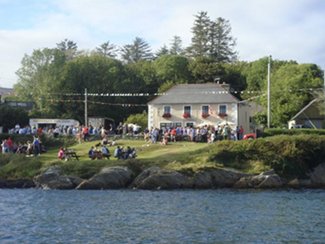
* The Tin Pub, Ahakista, West Cork - Graham Norton does a pub quiz once a year in this small, corrugated tin pub close to the Sheep's Head in West Cork. But don't let that put you off.

Do Ye Do Tinnies?

The Tin Pub is a joy of a place with a secret. Push out the back door of the little bar and there is one of the world's truly great beer gardens, a long lawn, bordered by high pine trees and flower-beds, running down to the little harbour.
Now THAT's A Beer Garden

A fantastic place to have a pint of cider on a hot summer's day. And if you don't like the sunshine, you can sit in the shed and look at the pictures of local Juniour B football teams. And if you are in the area, make sure to drop over in Billy O'Sullivan's on the pier in Crookhaven - a beautiful bar right on the pier wall serving amazing food. Get the Open Crab Sandwhich - it's like one of those bars you see on beer ads.


That's Billys - Try It, Just For The Halibut  
* The Ivy House - Nunhead - South East London

If you are ever south of the River in London - of a Sunday afternoon - you absolutely have to check out The Ivy House.

This is Britain's first community-owned pub. Basically, it's a Victorian masterpiece, the heart of a close-knit neighbourhood, a famous little live music spot (hosted everybody from Rory Gallagher to Dr Feelgood in the '70s. It's a beautiful old Gin Palace out front with an amazing little victorian music hall in the back.

And when developers tried to close it down and build apartments over it a few years ago - the local community got together, raised enough cash to buy it and now run it as a going concern/pub/community-centre/performance-space.

On Sunday afternoons - they regularly have big -band (and I MEAN BIG) orchestras play in the back for free.

It's a jewel, a beauty, and testament to a great community spirit. And they do great beer.


* Tom Barry's Bar - Barrack Street, Cork.

Like The Tardis - Bigger on The Inside


Showing a little bit of bias - Tom Barry's is around the corner from the house I grew up in. Lovely girls behind the bar, a great beer-garden and they photo-copy the Irish Times Crossword and leave it on the little tables inside the bar. With biros. If you are ever in Cork, drop in. And order the pizza from next door.

* Bifora Bar - Split, Croatia.

I could have gone for a number of pubs in this great town - built into the ruins of the Summer Palace of the Roman Emperor Diocletian - but the Bifora is a great example - a tiny, hole in the wall place in an ancient wine-cellar, hidden away in a tiny square. Split rocks, and the little bars like the Bifora are amazing. Also, Croats are cool. My aunt married one. And the local football team are Hadjuk Split. Hadjuk is Croat for "pirate", apparently.

That Emperor Diocletian Used To Drink Here All The Time  
* This Gaff, Brantome, France


Can't Remember the name of the bar, exactly, but it definitely ends in "Onnel" - Brantome is a tiny little village in Dordogne that's surrounded on all sides by a river and we spent an absolutely blinding afternoon there a while ago getting squiffy on local beers and wines while annoying the living feck out of the waiter by randomly ordering food for four hours. They had their revenge, of course, by charging us a small fortune. But that's France. It's one of those golden afternoons you remember long after you can't find your way back to the camp-site and end up in protective custody.

* The Dice Bar - Dublin

Scruffy, a bit down-home and definitely in the wrong neighbourhood (or the right one, depending on your point of view) The Dice is one of the best bars in Dublin. A kind of New York dive bar in a divey part of town. Great music, great beers and the Cobblestone is just around the corner if you fancy a mini-crawl taking in some trad music. You get some cool people and you can dance at the weekends. My own free-form jazz-dance interpretation of "Wave Of Mutilation" is something of a legend in the neighbourhood.

Tumblin' Dice


* The Island Queen, London

You Old Queen

Spending a lot of time in That London at the moment - and the Island Queen in Islington is already a firm fave - even if it is on the wrong side of town. Great burgers, great beer, a real gem tucked down a side-street. Ideal for watching rugby. Yes, it's a bit gentrified, but it's an original victorian pub with all of the fittings and the charm. You don't really get anything like this in Ireland, unless you count Ryan's on Parkgate Street. Another old favourite of mine.

* The Catford Constitution Club - Off (way off) Catford Broadway, That London.

Tucked down a side alley in the resolutely unglamourous neighbourhood of Catford, Sarf Lahndan, the CCC is almost literally off the map. An old Workingman's Club, it's been taken over by a group which specialises in (gulp) quirky pubs with great food. It's incredibly shabby and moth-eaten, but the '60s decor, dry-rot and bendy floor-boards give it a lot of charm. Make sure to visit before it collapses in a big pile of slates & wood dust.


Trust Me, I Wouldn't See You Wrong

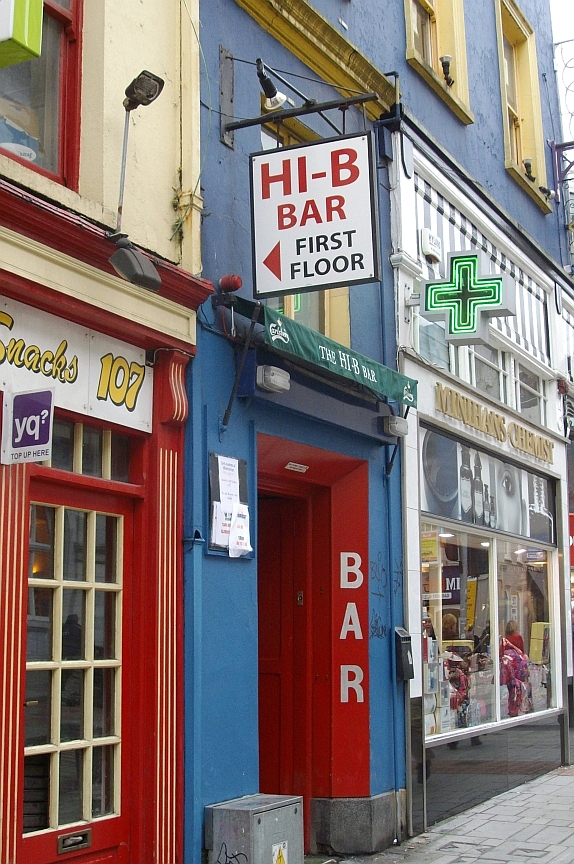
* The Hi-B Pub - Oliver Plunkett Street Cork

Another local favourite - I never go home without going through the door, up the stairs, through the other, smaller door and into this tiny bar that looks like your Granny decided to open a joint in her front room. The Hi-B is legendary, probably for it's owner (now retired, I think) who would respond to any request for anything other than an alcholic drink with a stern - "Feck off to McDonalds if you want a Coke". Seriously, you could get barred for ordering Pop or a Mineral Water. I saw it happen. It's a bit of a bizarre place. But really, really worth visiting. And also the marvellous Long Valley across the road, for the famous door-step sangwhiches and the lovely snug in the front. Trust me, Christmas just gone, I dropped in there for a pint with my wife an hour after we got married.

Up The Stairs to Your Right - Don't Ask for Mineral Water
* Grogans - Dublin
"I'm writing a novel" "Oh? Neither am I!" 


Everybody knows Grogans. The Last Chance Saloon for artists, writers and chancers who would have been big if it wasn't for ....THEM! It is my local (kinda, sorta) when I am in Dublin and I actually did check once to see if the regulars weren't actually screwed in place on the barstools. Seriously, I have never seen one of them so much as get up to go to the jacks. I like to sit outside and enjoy a cigarette and pneumonia. The toasted sandwiches are legendary. And fair dues to the staff for finding a way to recycle old ceiling tiles.

On friday night's in the summer, it gets absolutely rammed. Great if you get down early enough (say half an hour before noon) to grab one of the tables outside. Dublin is basically shite for outside drinking in the summer, there's Grogans, a couple of tables outside Peters and The Bailey and that's about it. Although I have heard rumours of a great beer garden in Toners which will be checked out in due course.

* The Idle Hour - Cork


On the docks, this old sailors pub has a great name, lovely guy running it and a fantastic, hide-away feel to it. Gets very busy at the weekend, but go during the week and enjoy the formica tables, gloss-painted wood panelling and the river outside. Lovely.


Now if you'll excuse me. I've got a bit of a goo on for a pint.


Monday, 31 March 2014

Sophie Toscan Du Plantier & The Beauté Sauvage of West Cork

* I've updated this piece from a story I wrote for the Irish Independent newspaper in 2010 about Sophie Toscan Du Plantier, the French film producer who was murdered at her remote home in West Cork, at Christmas, 1996. At the time, the French, exasperated by how the Irish investigation had gone, were trying to extradite Ian Bailey, the Englishman who was arrested and questioned about the murder but has always vehemently maintained his total innocence. As we know, this case is now very much back in the news.

This piece is about Ms Du Plantier, but also about this wild, beautiful part of my home county, a part of Cork which I know very well, having spent every summer there as a kid and teenager, and still making regular visits back. Many of my own happiest memories revolve around Crookhaven, Barleycove, Schull & environs. I think it's one of the most beautiful places in the world. But it has an often dark history - it was almost always desperately poor & isloated, it was was one of the worst hit regions in the Famine - and can be a strange, lonely place in the winter, when the Atlantic storms (or worse, endless days of mist and rain) batter or smother the rolling rocky hills, mountains and coastline....


Toormore is between Schull & Goleen - Bottom of the Map


Sophie Toscan du Plantier 


Talk to the French who have colonised West Cork and they will rhapsodise about its beauté sauvage.


Sophie Toscan du Plantier loved, more than most, that sense of being where the wild things are.


The sophisticated Parisienne often travelled to her isolated farmhouse on the Mizen peninsula in deep winter, when almost all of the affluent French, German and British blow-ins who summer around Schull, Bantry and Glandore were long gone.

West Cork, glorious and vibrant when the sun shines and the yachts are in, is a different country in the winter.

Conditions vary between furious coastal gales and days of thick sea fog and hill mists that suck any sound and light from the landscape.

The glacier-gouged, gorse-scrub landscape, so benign in high summer, can be sinister and claustrophobic as the days shorten.

The harsh landscape is reflected in West Cork folklore, chilling ghost stories and supernatural tales of banshees and menacing fairy folk who abduct unsuspecting travellers in the night.

I remember being in a farmhouse as child, on the Northside of the Mizen in 1979. The homes on this exposed side of the furthest point south in Ireland had only just been connected to the electricity grid. Some were still using kerosene lamps to light their kitchens at night. This was in 1979, as Apple Computers were building their first European manufacturing plant in Cork city - two hours drive away. 

In that same summer, we cowered in our caravan in the sand-dunes as a furious Atlantic storm hit the annual Fastnet yacht race, just offshore, killing 18 people, 15 sailors and three rescuers. The next morning, we walked up to Crookhaven and saw some of the battered yachts being towed in by fishing-boats. 

It is not so long ago. And while new roads and hotels have changed West Cork in the past two decades or so, it the winter, it still feels like a very isolated place.

Once the tourists are gone, many houses are deserted and most of the shops, pubs and restaurants put up the shutters and hang out their faux-cheery "Closed for the Season - See You Next Summer!" signs.

When Sophie flew into Cork, alone, on December 20th 1996, she would have seen the lights go out, one-by-one, as she drove west through Bandon, Clonakilty, Ballydehob and Schull.


By the time she reached the isolated townland of Toormore and turned into the dark, twisting boreen that lead to house in an small valley, she would have felt very alone.

The lights were on in the rustic kitchen, solitary pricks of light in the all enveloping darkness.
Sophie's housekeeper, Josephine Hellen, had lit a fire in the old fashioned grate and placed freshly picked holly, with bright red berries, on the windowsills to give the house a more welcoming, Christmassy feel for the lady travelling alone through the dark.


The night before, the 39-year-old film producer had enjoyed drinks with friends and her husband in chic Paris nightclub Les Bains Doucheson the Rue Bourg-L'Abbé.

Less than 24 hours later, the only light visible from the rocky hillside overlooking Roaring Water Bay was the thin finger probing through the sea mist from the lighthouse on the Fastnet Rock, eleven kilometres out to sea.

Her friends say Sophie loved the light from the Fastnet, she had her bed in the farmhouse's master bedroom specially raised so that she could see watch the narrow beam as it swept across the headlands every five seconds.


The interior of the house is as you would expect from a French woman who loved the idea of having an old Irish farmhouse, antique dressers, side tables and reed-woven stools.


When I returned to this area to write about it several summers ago, Toormore, with its nearby sandy beaches and rocky inlets, was bathed in spring sunshine and the white farmhouse stood out against the green hillsides in a little valley.

But as dusk fell, you got a sense of just how isolated the farmhouse was

Neighbouring holiday homes are often empty and the only light that was visible from the valley is the far off Fastnet lighthouse.

It is a lonely place, far from the main road that skirts the coastline and deadly quiet and dark after sunset.

When Sophie went there in the winter of '96, she travelled to the farmhouse alone, having tried but failed to persuade a couple of close friends to join her for a short Christmas break.

Sophie was not alone over the next 48 hours, she visited close friends and enjoyed a quiet sandwich and a cup of tea in the harbour village of Crookhaven.

But she was by herself when an unknown assailant called to her home in the early hours of Monday, December 23rd.

Her battered body was found, by a neighbour, close to the gate at the bottom of the road leading to her house shortly before ten am on that morning.

She had been dressed as if called from her bed in the early hours of the morning, her torn and bloodied dressing gown was found close to the body, there were bloodstains on the gate as if she had tried to scramble over it during the assault.

Sophie's mother Marguerite told staff at Cork University Hospital that she could only identify her daughter by the distinctive shape of her nose, the only part of her face still intact after the brutal attack.


Sophie's Parents at the home in Toormore - Pic Irish Examiner


When I visited some 13 years on from that winter night, Sophie's family had just taken the latest dramatic step in what has been a tortuous journey towards justice.


Iain Bailey, who has been arrested and questioned twice by gardai in relation to the murder but proclaims his total innocence, was facing an extradition request from
 Paris-based magistrate, Patrick Gachon. 


Gachon was appointed in 2008 ago to carry out an investigation into the murder after a long campaign by Sophie's family that included representations to the French President Nicolas Sarkozy. 

The extradition, as we now know, would not happen.

The white farmhouse in Toormore is today owned by Sophie's son from her first marriage, Pierre-Louis Bauday. 

Soft spoken and polite, Mr Bauday told me in 2010 that the house that so entranced his mother is still a special place for him and remains unchanged from when Sophie was alive.


He still travelled to the West Cork home every summer and when he goes, he passes the spot where his mother died, he sees the small Celtic Cross memorial with the single inscription, "Sophie".


"It was where I stayed with my mother, it has not changed, it is still intact and I prefer to keep it private," said Mr Bauday.

"I still go there, I will travel there in the summer, it is a beautiful place."


Publican Dermot O'Sullivan, who runs the family bar in Crookhaven, was one of the last people to see Sophie alive when she called into the pub on the pier on Sunday 22nd .


Dermot, who speaks French, had chatted with her as he did with most of the French customers who flock to the pub that Sophie loved for its famous seafood and views over Crookhaven harbour.

"We always chatted about the weather and the usual stuff, I got the sense that she was a very private person," said Dermot.

"I think she loved the peace and tranquillity that you get down here and I think she liked the lack of intrusion into her life."


"A lot of the Europeans who come here are looking for that, they tend to live pretty quietly, I suppose it's what they are looking for if they come from a big city."


"We are very busy in the Summer but it can feel isolated in the winter, especially when the weather is bad. But some people are looking for that."


Dermot said Ms du Plantier's death has left a "bit of a shadow" over the area, mostly because of the ongoing pain felt by her family who have yet to see justice done.


West Cork people, possibly because of their isolation, are famously hospitable and feel protective towards those who visit their townlands.


In the summer of 1996, months before the murder, West Cork was being written up in the British press as "the new Dordogne", an Atlantic seaboard colony for discerning celebrities, media industry figures, artists and taste-makers.

The London Independent newspaper and several glossy magazines ran features pointing out how it was now the second-home destination for everybody from Jeremy Paxman and Jeremy Irons to Sir David Puttnam and Edward de Bono. Chatshow host Graham Norton, himself from Bandon at the gateway to West Cork, now has a holiday home near Ahakista, about a half hour drive from Toormore and close to the Sheep's Head peninsula.


The word  from the Independent back in the mid-90s was that "the attractions of Sarlat and San Gimignano have paled besides those of Ballydehob and Skibbereen".


The terrible murder of Sophie Toscan du Plantier did not stop the influx of affluent, often powerful people looking for an idyllic, largely unspoilt home.


The stylishly renovated farmhouses and Victorian ex-parsonages and country homes that are hidden away down winding boreens or behind high walls still command big money, that's when they come to the market at all.

But the ghost of Sophie Toscan du Plantier still lingers, a spectral reminder that the savage Atlantic coastline can be baleful as well as beautiful.

ENDS

Wednesday, 26 March 2014

Omni-GUBU - A Short History of Significant Utterences in Irish Politics.

*Some random thoughts on the lyrical bent & tendency towards catchphrases of Irish Politics. Off the top of my head.

                        * On Mature Recollection, We Are Living Away Beyond Our Means


That Money Was Only Resting In My Account

GUBU!

That infamous acronym is everywhere again. And no wonder. We are in the middle of what the great French diplomat and political theorist Tallyrand once characterised as; "A total feckin' shite-storm".

One of those periodic National Traumas. Don't worry if you've missed it, there'll be another along in a while. Our state motto; "Omni-GUBU Ad Nauseum".

Commissioner Callinan will ride off into the sunset wishing that he hadn't taken the perfectly innocent adjective "Disgusting" and turned it into his professional epitaph.

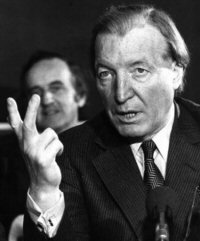
But it was Charles J Haughey's baroque response to another Irish scandal, the strange series of events (in the summer of 1982) which led to a double-murderer getting caught in the house of the Irish Attorney General, that is still our go-to phrase in times of crisis.

GUBU! .....It was text-speak before anybody had heard of social media or smart-phones. The early '80s equivalent of "WTF JUST HAPPENED!?"

It wasn't Haughey himself who coined it - but he did provide the inspiration. Say what you like about Charles J (try "Corrupt"), the man had a way with words.

When the news broke about on-the-run killer Malcolm McArthur hiding in the apartment of the State's top law official, Haughey spurred his metaphorical horse towards the heights of hyperbole.

"It was a bizarre happening. An unprecedented situation, a grotesque situation, an almost unbelievable mischance." He said.

It was Conor Cruise O'Brien who compressed Charley's thoughts and coined the phrase; GUBU - for Grotesque, Unprecedented, Bizarre, Unbelievable.

And as a handy acronym for describing how our Dysfunctional Republic works, it has never been bettered. Probably never will.

A small scandal breaks - usually by accident - and you can mentally picture the great and the good, the journos who cover them and the public who look on, putting on their tin-hats and bracing for far worse to come.

If there's one thing you can count on with an Irish political scandal, the first plop is always only the muted harbinger of several tonnes of shite about to hit the fan.

Unprecedented and Bizarre? Sure you haven't been paying attention, Make yourself some popcorn 'cos this is about to get EPIC!

It is a small island. And if somebody's been naughty, the chances are he has had the help, connivence or blind-eye of a few others. Who are usually well-connected to the people at the top. Or they are the people at the top.

So it's a good thing, then, that our politicians have a peculiarly Irish talent for minting a memorable phrase.

Sure, the Yanks with their "I did not have sexual relations with that woman!" or "Read My Lips - No New Taxes" are also good at this sort of thing.

But it takes an Irishman (or woman) to add a bit of poetry or drama. Or to bend words so that they sorta/kinda deal with the scandal or crisis, but also put them into the proper perspective. Smooth the events out a bit, point out that nobody is really at fault here, these are events beyond our control. That money was only resting in my account.

Politicians in other countries, when caught out, may try to spin or explain. In Ireland, they rail against cruel fate! Damn the stars that brought them to this sorry pass! They get dramatic, sentimental or lachrymose. They appeal to the plain people of Ireland (yes, those feckers).


Brian Lenihan Snr, on the main evening news, looking a beaten man, trying to explain away being caught out in a lie by turning to "Mature recollection". Looking back now, knowing how sick the man was and how he had been (unknown to himself) betrayed by his great friend, it is a very sad moment.


Another Fianna Failer, Gerry Collins, down on his knees, begging Albert Reynolds (who was out to topple his boss Haughey ) not to "bursht up the party!" Again, on the main evening news (which gets very Oprah more times than you would think reasonable).


It's not always hi-flown or tearful. Sometimes our politicians like to employ playful threat, such as when a Garda who was trying to intervene in a late-night drinking session involving politicians was asked; "You would like a pint or a transfer?"


The language our politicians use can be very revealing. Coalitions are "temporary little arrangements" - exasperated party leaders talk about "the f******g Peace Process".


Or it can be smug. Pee Flynn inviting the Late Late Show audience to try running three homes on an MEP's salary - "I wanna tell you, it ain't easy! You try it sometime!"


That was great TV - watching an odious creature like Flynn dig his own grave with those big shiny horse-teeth.

You'd Never Tire of Slappin' That


Charles J Haughey (again) telling an Austerity Hit Ireland (of another time) that we were "Living away beyond our means"...this from the Lord of the Manor in the Charvet Shirt. Living large on "political donations" and telling his bank, who had been trying to get back a 1 mill "loan" for years, to basically sing for it.


My own favourite? The exchange between the strait-laced company accountant James Gogarty, walking out of Minister Ray Burke's house after his developer boss had just dropped off a "political donation";


Gogarty;"Will we be getting a receipt?"


Boss (with a rueful laugh): "Will We F**k!"


That remains the perfect Irish political vignette. The honest, hard-working bean-counter (god bless his innocence) and the developer who knew how things actually worked.


Will things ever change? Will they F**K.