Wednesday, 8 October 2014

Roy Keane - The Latest Shocking Biog Leaks

* Roy Keane! He pulls no punches! And as the latest, often shocking leaks from his new biography reveal, Keano's in an almost permanent state of RAGE! Seriously, it's a wonder he doesn't get out of bed every morning and spontaneously combust. ARGH!

You may have already heard about the Robbie Savage "WHAZZUP!?!" story (and that one will haunt the peroxide blonde MOTD pundit until the day he dies) and Roy's running battles with everybody at Manchester United.

But using a highly placed source (shelf-stacker at Tesco's) - I have gotten my hands on some fresh, shocking stories from the biog. Which is about to make publishing history by being the only major autobiography to be read by the entire universe before it is actually on the bookshelves.

So read on.....

The Only Known Photo Of Roy Almost Smiling
Shortly after it was taken, he had the camera-man shot


*Early-Days

"One of my earliest memories is of watching me Mam trying to change my nappy. Now, it may sound strange, but even at the age of four months, I could already sense that her heart was not in it. It was fecking Amateur Hour, to be fair.

"Mam!" (I remember saying) "What's the fecking story, like? I could have changed four nappies myself by this stage!" Later on, as I expertly changed my own nappy for the fourth time that day, I apologised to her. I immediately regretted that. Never show weakness. People take advantage.

And by the way, in case you're wondering,  it's true. My s**t don't stink.


"Me In School - Never Understood The Nick-Name, Like" 


* School-Time

"You go to a new school and you have to let people know who you are, what you are about. So, first day, before they'd even put the jerseys out,  I walked up to the biggest kid in the school-yard and partially strangled him with a skipping rope. "There you go, Son!" (I said as four teachers and a janitor tried to restrain me) "Have a bit of that".

Later on that day, as the headmaster had a chat with me in a secure location, I almost felt like apologising. But then I saw the respect and/or naked terror in his eyes and I thought; "Job done, like. They know you're serious". It was an important lesson for everybody at the school.

"Fail to prepare - prepare to be partially strangled with a skipping rope."

Later on, I partially strangled two Norwegian defenders at Sunderland. And locked the club chairman in a wheelie-bin full of half-eaten Wagon Wheels. And that year? We got promoted.


I AM STARING INTO YOUR VERY SOUL

* Brian Clough And My Big Chance

"It was two days before the big game against Man U and Cloughie pulled me aside. "You, Irishman!" (I let that one pass. A lot of people didn't realise at the time I was actually from Cork). "You're a brave lad. A bit totally basterin' psychotic, mind, but I like that in a player".

The word was, he wanted to start me in the team, but didn't feel it was fair to drop the guy who was already doing a good job for him. The next morning, after the midfielder in question had accidentally run himself over with his lawn-mower, twice, I was in! Of course, some at the club wondered about the accident. Especially as the guy didn't own a lawnmower. And it happened in the men's fashion department of Burton's. But you have to take your chances in this game.

I don't own one of these - I just stare at the grass until it behaves


* Fergie And The Fish-Finger Incident


  "Standards had been slipping at Manchester United for some time. There was all sorts of moaning going on in the dressing room, silly stuff like "I'm not going to do extra training" or "Roy, I'm begging you, I'll try harder at Everton if you just tell me where you are holding my family!".

But it was in the canteen that the final straw happened. I walked in, cool as a breeze. And then I saw it. The Fish-Fingers were Tesco Own-Brand. Now, the last contract I had signed specifically promised Bird's Eye fish-fingers. And everybody at the club knew how I felt about this issue. Of course, there had been a time when Sir Alex had arrived at 5.30am every morning to check the fish-fingers and make sure there were enough of those fiddly tarter-sauce packets (you know, the ones you can't open and then you do and there's tarter-sauce all over your tracksuit? Those utter bastards?).

But as I said. Standards were slipping. Carlos "El Bastardo" Queiroz (I came up with that one. Ha. Ha.) had been put in charge of the fish-fingers. And the man hadn't a fecking clue. So I marched into Fergie's office and screamed about Captain BirdsEye for 15 minutes. The gaffer tried to put me off by saying "Roy, I haven't a f*****g clue what you're talking about, you mad Irish bastard". But he knew all right. Oh yeah. He knew.

Three days later I was out. Two days later I apologised and was back in again. One day later I completely lost it with a bowl of tartar-sauce and was back out again. Life's funny. Ha. Ha.

* What I have Learned From Football, Like.


"I have… seen things you people wouldn't believe… Attack ships on fire off the shoulder of Orion. I watched C-beams glitter in the dark near the Tannhäuser Gate. All those… moments… will be lost in time, like [small cough] tears… in… rain. Time… to die…"

* Thanks for reading. 


Friday, 3 October 2014

The Battle of Cable Street - Irish Dockers & Jewish Workers Against The Fascists

* The Brexit vote - and I'm still a bit traumatised - got me thinking about the UK's working classes - now being casually demonised by many as dumb, racist and worse, the idiot turkeys who voted for Christmas because they don't like seeing brown faces on their high street.

It got me thinking about a now almost forgotten moment in 20th Century Britain - when - as fascism rose across Europe - the working classes of East London united and fought street battles against the Blackshirt movement - and turned back the tide.

It was one of the most extraordinary moments in modern British history - and one group of often demonised, poor and ill-educated emigrants - or economic refugees - united with another - their enemies - to defeat the Blackshirts.

It was the Battle of Cable Street. And it was the Working Classes Wot Won It.

*********************************

* It's easy to forget. but in the 1930s, with the great democracies reeling from the Great Depression, Fascism was on the rise and seen by many as the future. And not just in Italy, Germany and Spain.

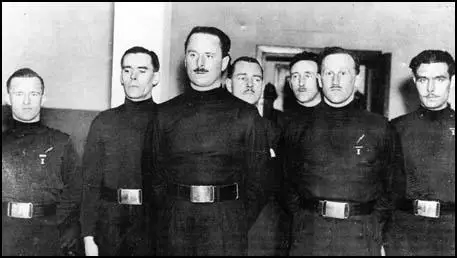
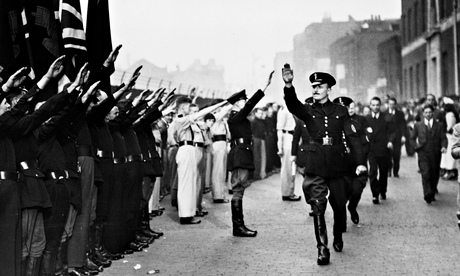
In Britain, firebrand and demagogue Oswald Mosley and his British Union of Fascists - the Blackshirts - represented a major political movement, at one stage, with over 50,000 members. And Mosely took his cue from Mussolini and Hitler, using the politics of hate, mass protests and paramilitary display to rally the disaffected masses and threaten their opponents.

Mosley & His Fascists 
It was a powerful, seductive message in a time of great want and turmoil. The same kind of message we are seeing all over Europe again today, in Greece, Hungary, France and even in Britain. You are not to blame for the sorry state your country finds itself in! It is the outsiders, the Jews, the immigrants, the left-wingers and liberals!

Fascism In London
And Mosely had his sympathisers, both with the Working Classes, who he claimed to identify with (despite being a toff) and many in the ruling classes. It has recently emerged that the British security forces investigated what amounted to a high-level fascist plot, involving many across the British power-elite of the time. Fascism, and the belief that it could triumph in Great Britain, were ideas that were in the air. As the Nazis shouted at the time, "Tomorrow Belongs To Us!"

The Daily Mail was an early supporter of the BUF - running a headline "Hurrah For The Blackshirts" that reflected not so much a great treason or extreme view on the part of the newspaper, but the wider feeling that democracy, or liberalism had failed and fascism offered a real alternative.

It was against this backdrop that Mosley organised what was to be his "March on Rome" - or at least a huge demonstration in the heart of London's most (as the BUF put it) "Jew-Ridden and Communistic" neighbourhoods. The streets around Whitechappel and the East End.

It was part of a campaign of terror already played out in Germany and Italy. Blackshirt gangs had been active in the East End, beating up Jews and Irish immigrants, breaking up meetings and trying to instil fear into their opponents while recruiting the disaffected to their flag.

BUF FLAG

Along with the Jews and Communists, Mosley and his men also had another target in the East End - the very large Irish community of dockers and their families. He had initially courted the Irish immigrants and found many willing to listen to his message. The Irish of the East End - escaping dire poverty at home - were not exactly known for their peace and goodwill to all men. Irish gangs would repeatedly chase Jews or others out of their neighbourhoods, graffiti such as "No Jews On Our Streets" would regularly appear on walls around Whitechappel. Many Irishmen joined the Blackshirts, Mosley's personal bodyguard for years was a Belfast man who later went on to advise the National Front and other Far Right Groups of the Post-War era.

BUF POSTER


So, on October 4th, 1936, as The Blackshirts prepared to stage their biggest ever demonstration in London, few could say for certain which way the Irish of the East End would line-up.

But for the large Jewish community, there was no question. If they failed to stand against the fascists now, they knew which way the wind would blow. They had seen what had happened in Germany.

But what would the Irish Catholic dockers, no friends to the Jews, do?

In the end - on one of the most remarkable days in 20th century Britain, the Irish dockers stood with the Jews, the socialists, the communists and the Union men as they fought back. And fight they did. The Battle of Cable Street saw ordinary men and women take to the barricades to force back the tide of Fascism in Britain. And it really did mark the high-water mark for Mosley and his Blackshirts, the point after which his movement went into terminal decline.

Mosley had rallied around 7,000 Blackshirts, the authorities had provided 10,000 policemen (4,000 on horseback) to make sure they could march against the expected opposition from left-wing groups and ordinary East Enders.

What happened was a furious street battle, as the East Enders threw up barricades, fought with the Blackshirts and Police and chanted the Spanish Republican slogan "No Pasaran!" "They Shall Not Pass!"

You can see footage of the battle in the vid below - the song is "The Ghosts of Cable Street", by The Men They Couldn't Hang.

And it is remarkable footage - this is London, in the mid-30s. An army of black-shirted, Sieg-Heiling British fascists fights running battles with ordinary men and women giving the closed fist Socialist salute. It could be Barcelona or Berlin.


****And here's a recent Channel4 news report featuring Max Levitas - who fought the Blackshirts (and who had a brother who fought with the Connolly Column in Spain (Max spent some time in his childhood in Dublin, you may hear a bit of an accent).

Click on this link - Max Levitas****

Mosley was planning a triumph in London before flying out to Berlin the next day to be married to Diana Guinness, formerly Diana Mitford, at the home of Nazi Propaganda Minister Joseph Goebbels. Adolf Hitler would be their guest of honour.
However, as Mosley and his men went into the East End, the anti-fascists learned that he was planning to march through Cable Street. 
On the 70th anniversary of the Battle in 2011, veterans like Professor Bill Fishman gave their recollections of the day.
“I heard a loudspeaker say, ‘They are going to Cable Street,’” said Prof Bill Fishman.
 “Suddenly a barricade was erected there and an old lorry was in the middle of the road. The people up the top of the flats, mainly Irish Catholic women, were throwing rubbish on to the police.
“We were all side by side. I was moved to tears to see bearded Jews and Irish Catholic dockers standing up to stop Mosley. I shall never forget that for as long as I live, how working-class people could stand together to oppose the evil of racism.”
Former textile worker Beatty Orwell, 94, was just a teenager when she joined the fight.
“I’d never seen so many people in my life,” she recalls.
“There was shouting and shoving, and the police on their horses pushing everyone back. When I spotted Mosley’s lot, dressed in their uniforms like Hitler’s men, I felt sick.
“There weren’t a lot of women there, but that didn’t put me off. We were all in it for a common cause, Orthodox Jews and Irish dockers standing together, when the Blackshirts came to Cable Street.”
Trapped between the barricades and besieged by huge crowds of determined anti-fascists, Mosley's men were forced back. And then the Police Commissioner went to the BUF leader and told him that he had to turn back. There was no way the fascists would march through the East End that day. 
It was a humiliation for Mosley. He had vowed to take over the East End and rally the working classes (many of whom had voted for BUF candidates in local elections) to the flag of fascism. What he actually faced was one of the most significant, single blows dealt to fascism in Europe before the War. The tide had been turned back, in Britain at least.
And while The Battle of Cable Street did not usher in a new era of socialism or universal brotherly love in London, it did show that the ordinary people could organise, fight back and beat the fascists.
As we look to far-right groups such as Golden Dawn in Greece and the English Defence League closer to home, it is a message worth remembering.
* Thanks for reading. 


Wednesday, 1 October 2014

Who's Taking The Horse To France? Ireland's Greatest TV Ads

* A chance encounter with an old friend recently threw up a phrase that meant a lot to us but would make no sense to anybody else in the London pub where we were enjoying a pint; "Who's Taking The Horse To France?" 

So this VERY IRISH SPECIFIC piece is inspired by that question - and is a tour of the Greatest Irish TV ads of all time. So pardon the nostalgia over-load, I'm prone to them. But it's just a bit of fun.

And apologies for the poor quality of some of the video clips - had to do some archeology on YouTube. 

The Way She Might Look At You


* Those who doubt the power of TV advertising should ask themselves just one, equine-related question; “Who's taking the horse to France?”

If you grew up watching telly in Ireland in the '90s, that apparently obscure reference should instantly transport you back to a kitchen full of Burberry checks, simmering sexual tension and buttery spuds.

One of a long line of memorable Kerrygold ads, this 1994 mini-drama, featuring a rugged Irish farmer and a classy châtelaine, over from France to buy a horse, gave us thirty seconds of the kind of sexual sophistication we didn't normally associate with range cookers.

An earlier Kerrygold ad had a saucy French trout fisherman called André, sidling up to an Irish B&B owner in her kitchen and asking “Allo? Zere is something I can 'elp?” It was a wonder she didn't drop the frying pan.

Here's a slightly dodgy video clip of the ad in question;


Our best TV advertising in the '80s and '90s often portrayed an aspirational, confident Ireland that would not arrive in reality until the era of the Celtic Tiger.

The ad men behind the Kerrygold brand were particularly adept at mixing the traditional with the modern, with strong, silent farmers and flame-haired colleens offering windswept Celtic allure and Hollandaise sauce to continental visitors.

Their muddy riding boots were hardly hitting the floor in the hall before they were ready to throw caution to the wind with a big knob of butter.

Last Tango in Borris. 

TV ads tended to have a much bigger impact when most homes only had a handfull of TV stations.

And you can probably date most Irish people by asking them to remember their favourite. For many of us, hearing Dusty Springfield sing “Goin' Back” instantly brings to mind a returning young emigrant, a country train station and a drive through the darkening fields towards a brightly lit farmhouse and mammy.

Younger folk will remember a young Michael Fassbender, swimming the Atlantic to New York, to say sorry to a friend. The soundtrack was Mic Christopher's “Heyday” and the product was, of course, Guinness.


The great British advertising guru, David Ogilvy (seen as an inspiration for the Madison Avenue Mad Men of the acclaimed TV drama), once said TV advertising was all about impact.

"You have only 30 seconds in a TV commercial,” said Ogilvy.

“If you grab attention in the first frame with a visual surprise, you stand a better chance of holding the viewer. People screen out a lot of commercials because they open with something dull. When you advertise fire-extinguishers, open with the fire."

Today's TV ads tend to move at a quicker pace as they jostle to grab our attention in a very crowded and diverse marketplace (you are as likely to see them on your PC or iPad as on TV).


Only time will tell if today's ads can hope to have the kind of lasting impact that the classic ones of the 80s and '90s had for that generation.

And if you had to draw up a top ten list of the Greatest Irish TV Ads of All Time – it would have to include;
  • 10 – Esat Digifone – The Guy from The Bar.

  • This simple but very effective ad played around with perceptions – the girl sees a gorgeous hunk at the bar, she slips him his number and he calls her up, only to bray “Howya, it's me – the guy from the bar!” in the most comically toe-curling midlands accent you'll ever hear.

  • 9 - Maxol - Free A Nipper
The early '80s were tough enough for this country without Brendan Grace – as Bottler – popping up on our TV screens every half-hour to shout “Free A Nipper – Roight?” But as a catchphrase (for Maxol Petrol Stations), it is as deeply embedded in '80s nostalgia as Ray Houghton's goal in Stuttgart and Charles J Haughey's “We are living away beyond our means”.

  • 8 Guinness – The Island
Better known for the catchphrase “Tá siad ag Teacht” (the only line of dialogue) – This legendary ad was first aired in 1977 and featured a pub full of Guinness drinkers, patiently waiting for a currach to deliver a keg of porter. In 1999, a poll in Marketing Magazine voted it the greatest Irish advertisement of the 20th century.

I love the sound design on this one - spectacular when you consider the period - the tick tock of the clock and the call of curlews ...


  • 7 Harp Larger - Sally O'Brien
“You could fry an egg on the stones here, if you had an egg” - this 1980 classic, with Sally O'Brien and the way she might look at you, had a huge impact on our popular culture. But there was a minor diplomatic incident when it turned out that “Sally O'Brien” was, Padraig Pearse preserve us!, English actress Viki Michelle, who later starred in the sit-com Allo, Allo!


  • 6 Penneys – Got A Whole Lot of Things For Christmas

  • Frist heard in the '80s and revived in the mid-90s, this simple jingle became almost a Christmas Carol for a generation of Irish TV viewers. Impossible to forget.

  • 5 - Bord Na Mona – Marino Waltz
First aired in 1986 - a shining example of a perfect marriage of a tune and a TV ad. You just cannot hear the opening bars of the lovely Marino Waltz without picturing a roaring fire, a deep leather sofa and toes warming up by the flames.


  • 4 – ESB – Going Back
    The young emigrant steps off the train at a country station, his dad is there to bring him home to a brightly lit farmhouse and mammy's cooking. A real-tear jerker from 1988 that still resonates with that generation, many of whom had to emigrate themselves. Trivia fact - the young emigrant is Alan Hughes, now of TV3 and Christmas Panto fame.

  • 3 News of The World – Breakfast With Bertie
“I never thought I'd end up here!” said former Taoiseach Bertie Ahern, from a food cupboard, in this ad for the now defunct News of The World Sunday newspaper. Classy, from the weirdo buffon who screwed our fair nation.

What you wouldn't give for the chance to slam a feckin frying pan into that gob.

A nation spluttered out its tea.


2 Guinness - Anticipation
Better known as The Dancing Man – this mould-breaking advert featuring rubber-limbed Irish actor Joe McKinney became an instant, worldwide hit on its début in 1994. The inspired choice of a Perez Prado track – forever known as “ The Da-da-dah Song” - heralded a golden era for Guinness advertising.


1 Guinness – White Christmas

Christmas ads are always the ones we remember best. And this brilliant 2003 spot for the famous stout, featuring snow falling on deserted places around Ireland on Christmas eve, evoked James Joyce's classic Christmas story The Dead, finishing with snow forming a creamy white head on the famous black gates of the brewery in Dublin.

It's the Dublin Christmas we all dream of. And of course, is ridiculously idealised.

Still, lovely stuff.


ENDS

Wednesday, 17 September 2014

No, Bob Geldof Should Not STFU - Scotland & The London Irish

* This is an edit of a piece I wrote for today's Irish Independent (and you can go out and buy the paper - it's a good habit to have). 

It's about Scotland, Dublin & two troublesome London-Irishmen - and the new generation of London-Irish - who may view the UK in a different way to the generations that came before them.

Thanks for reading! 


Sir Bob, Flying The Flag For Britishness 


*As the Scots passionately debate their identity and future, two London-Irishmen have spoken up to challenge our own sense of identity and self-worth. And been roundly slapped down for it.

Film-maker John Michael McDonagh delivered some (what he would consider) harsh truths for the Irish film industry and film-makers.

And in London, Bob Geldof managed to do something unique in the midst of this deeply partisan debate on Scottish independence, unite public opinion across these islands in loudly expressed belief that Sir Bob should (as so many tweeted) “shut the f**k up”.

McDonagh, in an interview given recently to publicise his latest movie, Calvary, said he did not want it to be considered “an Irish film” as he did not find Irish movies to be “technically that accomplished” or “intelligent”.

Cue a social media storm and howls from the cheap seats that if McDonagh didn’t want movies like The Guard and Calvary to be considered “Irish” – he shouldn’t have accepted €1.7m in taxpayer’s money from the Irish Film Board to make them.


And it is a good point. As is the point that McDonagh has no problem setting his non-Irish films in Ireland, filling them full of what you could call broad Irish stereotypes and then shooting them with an Irish cast and crew (despite their supposed technical failings).


Filmmaker John McDonagh - London Irish, Like! 


However, what many missed, in the rush to erect a scaffold for McDonagh, was that Calvary star Brendan Gleeson, in the very same interview, had some equally forthright views on the wider issue of Irish society and Irish people.

Gleeson talked about the sense of “rage” against the politicians, the bankers and the “paedophile priests”. But he added; “it tends to be muted and a little bit repressed”.
“People are not marching in the streets and burning buildings down, in the way, maybe, that the Greeks let off steam about their situation”.

Gleeson and others, have, of course, pointed to this peculiarity in the Irish psyche before, the failure to turn rage into action. But as a true-blue Dub and a national icon, the gruff, salt-of-the-earth actor has a licence to point these failings out to us. We welcome it and applaud him for showing a bit of passion. For giving us a well-deserved kick up the arse.

John Michael McDonagh, on the other hand, is London-Irish. The son of immigrants who has the temerity to come back, take our tax-payers cash and make films that take gleeful aim at what he judges to be the black, rotten heart of modern Ireland.

Bob Geldof is, if anything, worse. The only Irishman alive who Bono looks to and thinks; “Jesus, people really love to hate that guy”.


I'm Looking Into Your Very Soul

Geldof pushes a lot of buttons. He is a motor-mouth, ex-Blackrock College boy, a ferocious self-starter who got the hell out of Ireland to become a multi-millionaire and an honorary knight of the British Empire. And Sir Bob has been slagging off his native land since 1977.

But what Bob Geldof was saying about Britishness, at that Let’s Stay Together rally in Trafalgar Square, came from what he himself called “an immigrant’s gratitude” to the country to which he credits so much of his success.

The UK has been very good to Bob Geldof, who was recently said to be worth over €120m and who may believe that ‘80s Ireland in particular had nothing to offer him.
And as an Irishman living (mostly) in London myself, I can see where Bob is coming from.

Talk to the young Irish men and women who are here now (there are so, so many of them all over this great city and the Irish networks are still strong) and you don’t hear the misty-eyed regard for home that you might have heard in the ‘80s.

You don’t hear much if any anti-British sentiment. Mostly, they recognise the opportunities that London gives them and the energy, industry and cosmopolitan buzz in a city that is all about getting on and getting ahead.

Yes, London can be a very tough place. Rented accommodation costs on average 50 per cent more than in the rest of the UK.

But for many thousands of young, educated and hard-working Irish people, London and the UK is a place where talent meets opportunity. They may still think Scotland should take its chance to go it alone. 

But they are perfectly comfortable living in the land of our former oppressor and not really all that hung up on “800 years” and all that. Unless, of course, Ireland are playing out west in Twickenham.

They may not have a hell of a lot in common with Bob Geldof. But like him, they can appreciate what relocating to the UK has allowed them to do. And would probably think the concept of Britishness – as the idea of an open, tolerant and vibrant society - is at least worth defending.

Scotland will decide tomorrow. But many of the Irish voices you hear now in every corner of London have already made their minds up. Britain, for them at least, is working.

THE END!  

Thursday, 28 August 2014

Ireland Is Batshit Dysfunctional & Run By Crazy People - A Calm, Considered Look At The Republic.

* I'm not claiming any great insights here. This is what you will hear being moaned into pints in every pub in the country (especially if you sit near me). But it's a kind of therapy to write this down. So thanks for sharing my pain.


"Insanity; Doing the same thing over and over again and expecting different results" - Albert Einstein. 


"Well, At Least We're On The Property Ladder" 
* Here's an interesting fact for you. The new-ish prime Minister of Italy, Matteo Renzi, was born in 1975. In the same year, a 25-year-old Enda Kenny was first elected to the Dail, after the sudden death of his father, Henry Kenny. 

In Ireland, parliamentary seats, like the family pub and a fondness for the horses, tend to get passed down from father to son. 

Now. Age, it should be said, is no bar to having fresh ideas, radical thinking, energy or vision. 

However, Enda Kenny - and many like him at the top of Irish politics - have been inside the deeply dysfunctional Irish political system for decades.To use a term normally applied to prisoners doing life, they have become institutionalised.

The current Government came to power at a time when Ireland was faced with a terrible crisis - but also a once-in-a-century chance to completely reform Irish political and public life, to chart a radical new direction, to finally get to grips with the deeply ingrained faults which we all, whatever our political beliefs, can agree are there. Only a madman would have argued for the preservation of the status quo. Business as usual. 

But that is exactly what happened. And we only have to look at the latest housing bubble/crisis/insanity for proof of that. 

Dublin is, right now, experiencing the kind of property madness that saw us - less than a decade ago - sprint up to the edge of the cliff, have a little look and then take a flying leap. 

It's not just the lunacy in the way the cost of a home is soaring. A report out today says one third of families are cutting back on spending on food for their children so that they can pay the rent or mortgage. 

This is something we should care deeply about. We should be shouting about it from the mountain-tops. But maybe we've just been battered to the point of emotional exhaustion. Or worse. Apathy. 
Many friends of mine are either taking a desperate leap onto the property ladder or struggling to pay ever-increasing rents. Dublin has become a city where it is - unless you are very well paid or have money already - getting daily more impossible to live. 

Meanwhile, in other parts of the country, in the midst of a housing crisis - we are actually knocking down the houses built on ghost estates during the boom - which was fueled by morons, spivs and outright criminals.

And what is the Government housing policy?  Some tinkering with the rules surrounding getting a mortgage - but other than that - let the market sort itself out. Because that's always worked well for us before.

We did look at other ideas, a proposal for a Danish style mortgage model was shot down (a bit to Scandi & sensible for a nation of gamblers like ourselves), there was some talk of more affordable social housing, decentralisation, yadda, yadda, yadda. All came to nothing, of course.

But we can't just blame the pols. It's a simple truism, but you really do get the Government you deserve. And we voters have shown, time and time again, that we are unable to act in our best interests. The innate conservatism and inertia in the Irish psyche, this weird mix of fatalism, self-interest, tribalism and (perversely) sudden urges for a mad gamble, keeps giving us Governments that are incapable of clear-sighted, long-term strategy. And change.

Bertie Ahern - The Irish Id Made Manifest

In Sigmund Freud's psychoanalytic theory of personality, the Id is the personality component made up of unconscious psychic energy that works to satisfy basic urges, needs and desires. The Id operates based on the pleasure principle, which demands immediate gratification of needs. 

In Irish terms - the Id is Bertie Ahern. It's easy credit, a nice car, good house, three holidays a year, maybe a little place close to a golf course in Marbella. It's live for today. Keep everybody happy. Keep property prices rising. And vote for the guys who'll fix the roads but f**k the future. 

It's this bizarre obsession with property prices, with driving the value of a house ever upwards, even if it means that a good home in a nice area flies far out of the reach of young families. Or becomes a massive burden. Your children (literally) going hungry. 

It's a kind of collective madness. We are in thrall to our Id. 

And it's maybe why we haven't got a proper reform movement in politics. Why we passed on a once in a century chance to press the reset button. Start again. Get the best minds working on a plan for the future. 

So we'll blow up another bubble, run up emigration to famine levels, leave our best and brightest, our children, get off this island because, let's face it, there's no real future for them here and we're not really that interested in giving them one.

The really crushing aspect of all this (no, seriously, put down the revolver) is that we could actually fix this. It's been done in other countries. We can take a long, hard look at the problems, survey best practice and our smartest people and chart a new course. So what are the chances of that happening under our present system and our Lifers in the Dail? 

I'll always try to avoid fatalism. But my country makes this really fecking hard. 

*Thanks for reading. Now go hug a kitten or something. 


Thursday, 14 August 2014

The Lost Banner - Or How The Queen of England Bagged A Relic of the Easter Rising


* I visited the Imperial War Museum in London this week. Newly reopened after a £40m facelift - it is a spectacular experience, right from the moment you walk in and see - hanging from the ceiling - a WWII Spitfire fighter plane and a Nazi V2 Rocket - the direct forerunner of the rocket that sent man to the moon (both designed by Nazi scientist and slave labour enthusiast Wernher Von Braun). 

But just as I was exiting the new, incredible WWI Gallery, I spotted something that looked out of place. An Emerald Green and Gold Banner, with a starburst motif, run through by a pike. It said "Fianna Eireann". When I looked into the history of how this Irish Republican artefact got to be hanging in the Imperial War Museum, I found and interesting story involving two very famous women.........


Up The Banner


At the start of May, 1916, as Dublin city centre was a smoking ruin and the survivors of the Easter Rising were being put in jail or rounded up for internment, soldiers from the 3rd Battalion, Royal Irish Rifles went to a house in the suburb of Rathmines.

They had been detailed to search the home of Constance Markievicz, the British-born woman who had commanded Republic Forces during fierce fighting in St Stephen's Green. A radical socialist, Irish nationalist and suffragette, two years later, Countess Markievicz (she had married a Polish Count) would be the first woman elected to the British Parliament.

On this day, however, she was imprisoned in Kilmainham Gaol. On May 6th, her sister Eva Gore-Both and her friend Esther Roper went to her empty home at Surrey House in Rathmines. When they arrived, they found that it had been occupied and ransacked by soliders from the Royal Irish Rifles, under the command of a Lieutenant-Colonel W.E.C McCammond. 

The countess had taken part in fierce fighting in St Stephen's Green, at one stage shooting at, and wounding, a British Army sniper.
The Countess In Irish Citizen Army Uniform
Which She Designed.
Amongst the items taken by the soldiers was a Green & Gold Banner of the Republican youth movement the countess had formed in 1909, Na Fianna.

The banner had the motif of a pike (symbol of Irish uprisings since the 1700s) on a sunburst, backed by a field of Emerald Green. The slogan was (in the Irish language) : “Glaine ár gcroí, Neart ár ngéag, Agus beart de réir ár mbriathar”. 

Which translates (loosely) as "The purity of our hearts, The strength of our limbs, Our commitment to our vow".

That banner is now hanging in a corner of the Imperial War Museum's new World War I gallery(which is mightily impressive, by the way).

And if you read the little plaque next to the banner, at the end it informs you; "Lent By Her Majesty The Queen". 

It's a strange thought, that this relic of a terrible, turbulent time in Irish history, found its way into the hands of the British military and then into the private collection of the Royal Family, now headed by Queen Elizabeth II.

I doubt the queen has it hanging in Buck House. Although you never know. 

There is a campaign to have the banner returned to Ireland, possibly to Sligo, which claims links to the Countess.

That is something to be decided further down the line. For now, I'm glad it is hanging there in the Imperial War Museum, a small but very potent reminder of the time when, as 200,000 Irishmen served in the Allied Forces fighting in Europe and in Turkey and the Middle East, thousands of their fellow countrymen were involved in a different fight at home. 

**** Thanks for Reading**** 

Thursday, 24 July 2014

Humphrey Bogart & The African Parrots of South London.

* This is a curious tale of animal invasion that I only recently became aware of, mostly through running in the parks of South London. It's a pretty well known one to Londoners, but I thought I might share.....


"Oo are you calling a pretty boy, then?" - Parrots of Telegraph Hill, London
 * Go for an early-morning run ....in the parks of South London and you'll see many sights, some of them scary, others curious (such as the stained mattresses that apparently roam the streets of Lewisham, seen standing against walls and in overgrown front gardens, frozen, troll-like, by the first rays of the rising sun).

You'll see bleary-eyed commuters rushing for the train, the occasionally late-night party-animal struggling home or homeless guys crawling out of improvised bivouacs under the shrubbery.

But what greeted me on one such run recently was something entirely unexpected. A flock of vermillion and emerald-hued parrots, swooping low over the crest of our local hill, against the backdrop of the London skyline.

I was literally stopped in my tracks. A flock of parrots? Half expecting to see a giraffe standing outside the off-licence at the bottom of the hill, I eventually ran on and got home to do a bit of googling.

And that's when I found out that there are an estimated 30,000 Feral Parakeets (not an '80s New Wave band, BTW) happily living (mostly) south of the river Thames, in suburban back-streets and the wide-open green spaces, parks and commons that you will find everywhere in London.

And the story of how they got here is fascinating.

Parrots In the Park - South London


The birds are mostly Rose Ringed Parakeets. although similar flocks of Monk Parakeets have also been spotted. They are an afro-asian bird, not something you would expect to see in Catford, Twickenham or Tooting Bec.

And the theories as to why they are here are many, some are almost as exotic as the birds themselves.

The birds may have originated from just one breeding pair released into the wild. And one popular story is that this pair were released by Jimmi Hendrix on Carnaby Street in London during a photo shoot in 1967.

However, there are also theories that a flock of parrots staged a breakout from an aviary during the great storm of 1987. Or that a container full of illegally imported parrots broke open at Gatwick airport in the early '90s.

My own favourite story is that they are all descended from parrots imported from Africa to England and featured in the studio scenes of the classic Humphrey Bogart/Katharine Hepburn movie The African Queen, shot by John Huston in a south London film studio in 1951.

As the story goes, when the movie was over, some studio tech simply opened the main doors and the birds flew out, to establish breeding colonies all over South London.

Given the Bogie connection, I'd like to sidle up to one of them and say; "You know how to whistle, don't ya?"

They have adapted to survive harsh London winters and managed to slot themselves into the eco-system (possibly by learning to love the most common South London food source, the Abandoned Kebab).

However, they got here, I've certainly come to appreciate them, especially during the current heatwave, when they add a bit of tropical colour to the blazing blue skies.

They certainly brighten up every early morning plod up and down the hills of south London. And added to my stock of Avian Tales of London, which also includes the true story of the Pigeons who have learned to ride the Underground.....

* If you want to know a little more - here's a link to a clip from a BBC wildlife doc that talks about the parrots ..... thanks for reading... - Clip https://www.youtube.com/watch?v=p4P_NhFlb5w


ENDS