Thursday, 29 January 2015

The Cold War Bulgarian Umbrella Killers Of London


* The newly opened public enquiry into the horrible killing of Russian dissident Alexander Litvienko in London is already throwing up plenty of details that will be embarrassing to the Kremlin in general and Vladimir Putin in particular. Assuming that Vladimir Putin can actually experience embarrassment.

But Litvienko was not the first Eastern dissident to be assassinated in London. And one of the previous cases has eerie similarities with the polonium poisoning case.

So read on.......


Georgi Markov
     * Two secret agents track a man through the streets of busy streets London. They have followed him in and out of cafés, on the Underground and along pavements, trying to engineer a chance encounter. The Eastern European spies have already tried at least once to get close enough to administer a deadly poison to their target. This time, in one of the busiest spots in central London, they are successful. The poison is delivered. The target - a writer and journalist who has been deeply critical of the regime in his native country - has barely noticed anything. But soon he will tell his colleagues and family about a sudden rash, a rapidly developing illness. He is taken to hospital where doctors are mystified as to the cause of his rapid and unstoppable decline. He insists he has been poisoned. He raves about KGB assassins sent by political masters in the East, his former homeland.  

Within four days he is dead. 

If you have been following the case of Alexander Litvienko, this scenario will sound very familiar. Exotic poison, assassins from behind what we once called the Iron curtain. A brazen political killing on the streets of London.

But this is actually the story of Bulgarian writer and dissident Georgi Markov, killed on the instructions of a communist secret police in London in September 1978. I remember reading about it when the real story started to emerge in the early '80s and the impression that it made on me. This was a fictional spy thriller come to life. They had killed him with - of all things - a poison tipped umbrella.

Markov had been a writer, a dissident who moved to London to escape persecution in his native Bulgaria and worked for the BBC and (more infuriatingly for the Communists) the US-Funded Radio Free Europe, a network of polyglot stations, broadcasting directly into the Communist Bloc with news, political views and music that the regimes there did not want their people to hear.

Markov In London

On September 7th in '78, Markov was walking across Waterloo Bridge in London, going to catch a bus to his job at the BBC. As he stood at the bus stop, he felt a sharp sting on the back of his right thigh, as if he had been bitten by a particularly big bug. 

He quickly looked around and spotted a man picking up an umbrella and hurrying away to grab a taxi.

Markov was a little shook but continued on to the BBC, where he told colleagues about what had just happened to him and showed them a little red raised bruise on his thigh.

That evening he developed a fever. Shortly after he was rushed to hospital - where doctors were unable to establish the cause of his sudden and rapid deterioration. Markov insisted he had been poisoned by the man with the umbrella. Four days later he was dead, aged 49.

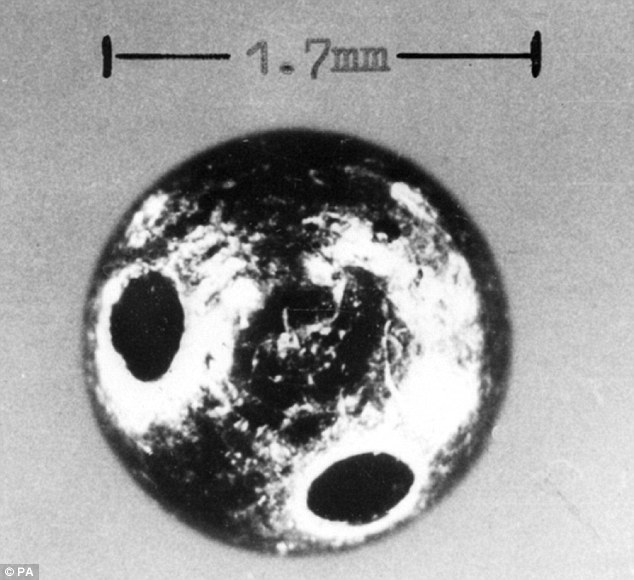
It was established that the cause of death was a metal pellet the size of a pin-head, a hollow ball, filled with the deadly poison Ricin. Even if the doctors had known the nature of the poison, they could not have treated him. There was no known anti-dote for it at the time.

Investigators later deduced that the pellet had been fired from the tip of an umbrella, using a pneumatic system similar to an air-rifle.

Diagram Of Suspected Umbrella Gun


The police and secret-service agents investigating the death then discovered that just ten days before the fatal attack on Markov, the exact same method - a poison-tipped umbrella - had been used in an ultimately unsuccessful attempt on another Bulgarian dissident on the Paris Metro.

The Actual Pellet Taken From Markov's Leg


It has long been believed that the Bulgarian secret police, backed by the KGB, used a Danish man of Italian heritage - Francesco Gullino - to carry out the actual attack on Markov. Gullino was said to be an art dealer turned drug smuggler who had been captured by the Bulgarian police and given the simple choice - work for us in the West or spend the rest of your live in a Bulgarian jail.

Gullino - codenamed "Picadilly" by the British secret service - has never been apprehended and is believed to be still travelling, under several false identities in Europe to this day.

There are many strange similarities between the case of Markov and that of Litvienko, poisoned with radioactive polonium in a London coffee shop.

The family of the Russian must hope that they get a better shot at final justice than those who loved Markov ever did.

****THANKS FOR READING*****


Monday, 19 January 2015

Captain Jack White - The British War Hero Turned Anarchist Who Drilled The Citizens Army

* Regular readers may, by now, be familiar with my obsession with the lesser told, quirkier stories from history in general and Irish history in particular.

With the Centenary of the Easter Rising on the horizon, we are going to hear a lot of familiar stories, the headline names of 1916 and lots about what that armed revolution means to modern Ireland (not a hell of a lot, in my humble opinion. Whatever those men had in mind for this island, what we have now comes nowhere close. It was just another chapter, now long past.)

But I'm drawn to the figures and stories on the periphery of the Rising, The ones mostly forgotten now, or written out almost from the start because they didn't fit the conventional narrative...

And so I've long be interested in the story of Captain Jack White. A hero of British imperialism, turned radical socialist, then anarchist, a man who lent his life to a series of lost causes. A man who was, in his own word, a misfit.

So here follows a brief history of a fascinating man......


Captain James Robert "Jack" White  
* A handsome man with an unmistakeably military bearing. Dressed in civvies but holding a rifle. Captain James Robert White, always known as Jack, is largely forgotten in Ireland, Britain and Spain now. But for a long while, he was at the centre of great events.

Through his life, he believed in socialism and the collective cause and destiny of the working classes. And he believed in their right to organise, arm, drill and fight.

It was Jack who organised the Irish Citizen Army, after seeing the strikers in the 1913 lockout - the bitter struggle between the unions and the employers - getting knocked about by the police and strike-breakers.

White - who by then had left his official soldiering days with the British Army far behind him - saw the need for a disciplined force, a Citizen Army that could, as he said, "put manners on the police".

White was the true born son of the Empire, He was born in 1879 on the family estate in Co Antrim in the North of Ireland, the only child of a full British Field Marshal - Sir George Stuart White VC, GCB, OM, GCMG, and so on. Sir George had won Britain's highest military honour, the Victoria Cross, fighting the hill tribes in Afghanistan, in the year his son was born.

Jack was educated at Winchester (from which he was expelled) and the Royal Military College at Sandhurst. He began his fighting career aged just 18 with the Gordon Highlanders fighting the Boers. And he was awarded the Distinguished Service Order for an act of great bravery and initiative.

However, it was also in South Africa, during that bitter war, that Jack first showed signs on a very un-imperialistic streak. During one furious battle (as he later recalled), a 17-year-old soldier in White's section lost his nerve and stayed shivering in his trench. A senior officer called to the young Lieutenant White; "Shoot him!". When Jack did not move, the officer moved towards the youth with his own side-arm out. Jack is said to have drawn his gun, covered the officer and coolly told him; "Do it - and I will shoot you".

There was further some service with the army in India, but it seemed Jack White and the British army were destined to have a parting of the ways.

He returned to his native Ireland and became interested in radical politics, then a huge draw to many young members of the aristocracy with questions. He dropped out of society, travelled to Canada to work as a lumberjack, taught in various schools and joined a radical commune influenced by the writings of Tolstoy (Jack actually wrote letters to HG Welles and Tolstoy to explain his new course in life, Tolstoy is said to have written back approvingly).

The commune, in the English countryside, also welcomed practitioners of Free Love. It was pretty radical stuff for the son of a full British Field Marshal in the 1900s.

It was this romantic search for something new, something better, that eventually brought him to Dublin, where he met with the Scottish born, Irish socialist leader James Connolly. The two men, who could hardly have been from more different backgrounds, struck up what became a very strong and enduring friendship.

White got caught up in the labour battles around the time of the 1913 Lock-out. He saw the ranks of the union men broken up by police batons and decided it was time for them to fight back.

Captain Jack White (carrying the flag) with the Irish Citizen Army

White organised, drilled and commanded the Irish Citizen Army. Which would go on to fight in 1916.

White did not fight in 1916. He had been organising a Volunteers brigade in Derry, but was very disillusioned by the sectarian, anti-Protestant views he encountered there. He also managed to fall out with his fellow protestants who put sectarian beliefs before the unity of working people. It was to be a motif throughout his life. It seems that Jack White was always on the search for purity of belief and deed. And he would always be disappointed in his fellow men. Those who put nationalism, religion, class prejudice, a thirst for power or control, above what he saw were the simple tenants of socialism. When he appealed to the Irish Volunteers for unity with their fellow protestant workers, they often accused of him "looking out for his own" and questioned his commitment to the glorious cause of Irish freedom.

But White could be just as difficult with his fellow Protestants he believed that true Protestantism should be behind those who wanted a better, fairer world for all. Not just Orangemen and the sons of land-owning British Generals.

To the Protestants, he was always a "Shinner". To the Republicans, an Orangeman, a toff, ex-British Army and the son of a General. Not for nothing did White call his autobiography, written in later life when disillusion had largely taken hold; "Misfit".

When Connolly (his great friend) was sentenced to death after the Rising – White tried - in vain - to organise the Miners of Wales to go on strike to save his life. 

He later travelled further to the left, joined with Sylvia Pankhurst’s Workers Socialist Federation in England, organised a communist republican group in Ireland in the 30s before joining the anarchists in Spain during the civil war.

Jack White volunteered for the Red Cross in Spain and helped organise the Connolly Column and was thrilled to see Irish protestants and Catholics, all socialists and communists, fighting together for the people. He also distributed handguns to the women of towns and villages around Madrid and drilled them in how to protect themselves. White may have been high-minded in his politics but he was always a practical man. When a fascist is advancing on you, better to have bullets over banners.

Once again, White eventually became disillusioned with the in-fighting and betrayals, becoming avowedly anti-Stalinist and leaning more towards the Anarchists, the only keepers of the pure flame. In this, he was following a similar path to George Orwell, another ex-Imperial policeman. 

He returned to the family home in Co Antrim, shortly before the outbreak of the second world war. There was a brief reappearance in Public life when he tried to stand as a "Republican Socialist" candidate for Antrim in the 1945 general election, but by then those who knew him at all regarded him as little better than an eccentric, rowing pointlessly against the tide of the times.

Jack White died of cancer in a Belfast nursing home in 1946. His family, embarrassed by his revolutionary past, burnt almost all his papers and writings shortly after his death. 

He was a remnant of a strange, romantic, heady time, when many upper-class English men and women, bred to Empire, decided on a radically different course and fought for universal socialism and the rights of every man.

In his beliefs, he was a radical, a puritan, a believer in the essential brotherhood of men and their desire for a just and equal world, He believed, passionately, that you only had to give people the means to fight and the cause to fight for and they would follow.

He was destined to be disappointed. In the end, disowned and hated by Republican catholic and protestant unionist, Jack White was, as his own epitaph said, the eternal misfit.

*** Thanks for Reading! And Don't Forget to Share If You Enjoyed - Tip Your Blogger***** 


Tuesday, 13 January 2015

Hot Potato! Alan Partridge, Charlie Hebdo and C4's Modest Proposal For A Famine-Com

* This Saturday in London, a group of protesters intend to march to the HQ of broadcasters Channel 4 to voice their anger over a proposed sit-com - set around the Irish famine.

The march is being organised by the Campaign for the Rights and Actions of Irish Communities - the rather ironically acronymed CRAIC.

The protest was organised before the Charlie Hebdo outrage in Paris. And it may seem crass to draw comparisons. But you might think it's a little strange that as the world shouts for  freedom of expression and artistic licence to take on even the most controversial subjects and issues, a fair proportion of Irish people are vehemently opposed to a comedy script that hasn't even been fully written yet.

It's not as if humorists haven't worked with subjects like millions of starving Irish people or the holocaust before. 

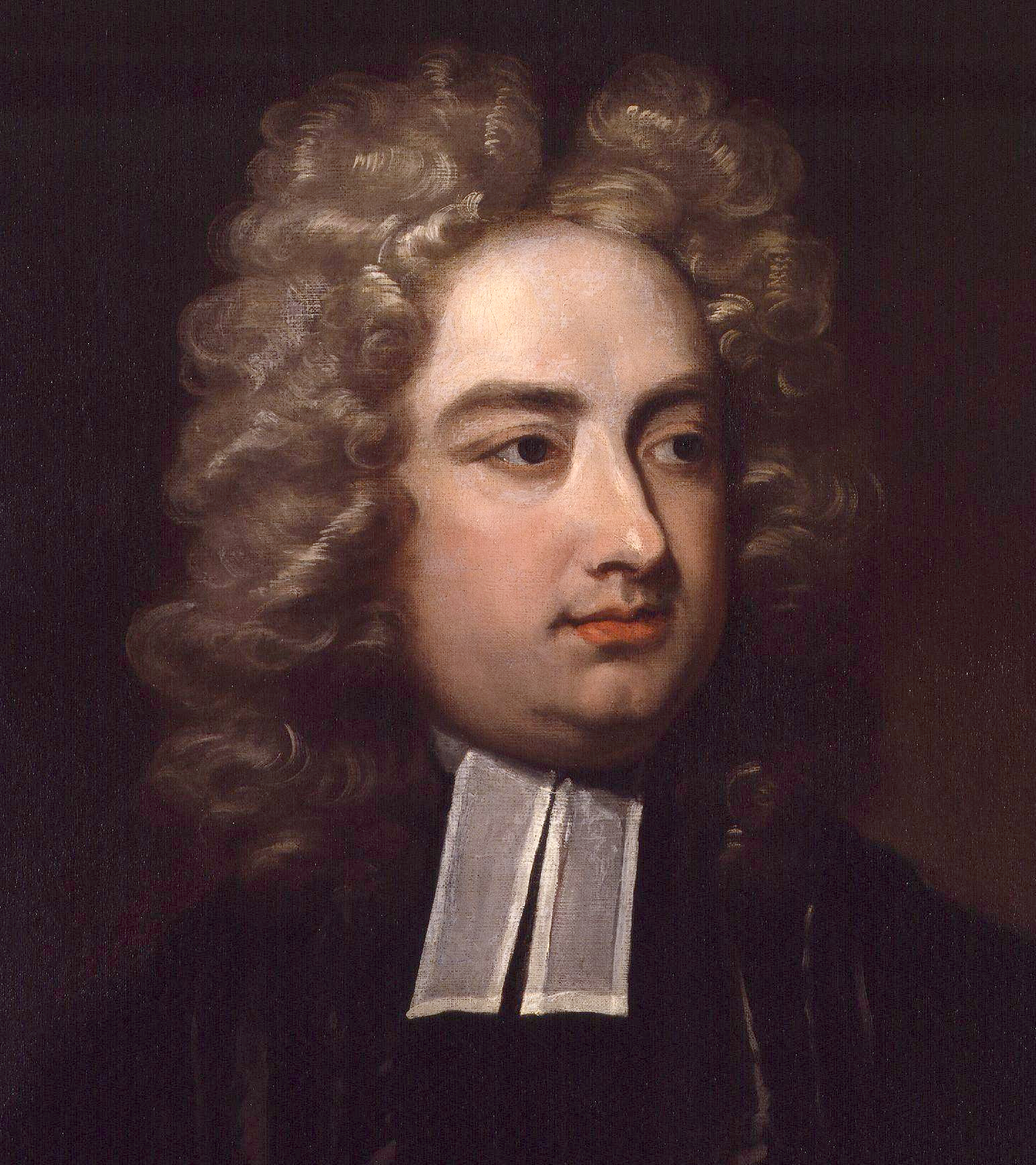
Irish satirist Jonathan Swift once made a “modest proposal” that the starving Irish could ease the burden by selling their children as food for rich Lords and Ladies. He was joking, of course.
Auld Swifty - He Also Did Fart Jokes

Jewish comedians such as Mel Brooks, Charlie Chaplin and Joan Rivers satirised the Nazis. And the late Rivers got into serious trouble in 2013 by observing of the German supermodel Heidi Klum; “The last time a German looked this hot was when they were pushing Jews into the ovens.”
Answering the outrage generated by her Holocaust joke, Rivers said: “My husband lost the majority of his family at Auschwitz, and I can assure you that I have always made it a point to remind people of the Holocaust through humour.”
Der Furher Was A Wunnerful Dancer! 

Monty Python were accused of sacrilege because of “The Life Of Brian” while the Blackadder team mined comedy gold from the horror of WWI trenches.

Comedians and satirists have always played with fire when it comes to grim historical events. But it could be argued that the best, like Swift, have used humour as a weapon against evil. As well as making us laugh. 
Anyhow!  I talked to Irish comedian, satirist and impressionist Mario Rosenstock, and Professor Gary Murphy about this, ahem, hot potato. 


Knowing Me, Knowing Potato Blight

* The Great Famine!  It’s no laughing matter. Unless you are Channel 4 or Alan Partridge.

In one classic, 1997 episode of the BBC comedy I’m Alan Partridge, the hapless TV presenter sat down with two Irish TV executives, played by Fr Ted writers Arthur Mathews and Graham Linehan.

Alan blundered into the subject of the Famine, asking a clearly uncomfortable Linehan (playing TV exec Aidan Walsh); “So, how many people were killed in the Irish famine?”

The Irishman replies; “Two million. And another two million had to leave the country”.

Patridge observes; “Right. It was just the potatoes that were affected? At the end of the day, you will pay the price if you are a fussy eater. If they could afford to emigrate, then they could afford to eat in a modest restaurant”.

If you thought that joke was in desperately poor taste, you may be one of many thousands who signed an online petition this week to demand that Channel 4 drops tentative plans for a sitcom set during the Famine.

Irish comedy writer Hugh Travers has been commissioned by the British broadcaster to write a pilot script for a “black comedy”, working title Hunger, set during the period around Black ’47.

It is to be produced by Deadpan Pictures, a spin-off of the Wicklow-based production company Grand Pictures, the people behind hit comedy Moone Boy.

“This is in the development process and is not currently planned to air,” said a C4 spokeswoman. “It’s not unusual for sitcoms to exist against backdrops that are full of adversity and hardship.”
Hugh Travers, best known for the RTE radio comedy-drama Lambo (a fictionalised account of the moment the late Gerry Ryan confessed to killing a lamb on The Late Late Show) told one newspaper about his thought process.
“Why the famine? Well, they say ‘comedy equals tragedy plus time’. I don’t want to do anything that denies the suffering that people went through, but Ireland has always been good at black humour”.
Travers may be shocked by the furore generated by his development script.
But another Irish comedian and comedy writer, Mario Rosentock, believes one factor in the outrage generated is social-media in general and Twitter in particular.
“Quite clearly, people are only too ready to jump on the outrage bandwagon,” says Mario.
“They can use this 140-character outlet to make a name for themselves, to get noticed. Twitter is like going into a bar and shouting at the top of your voice until everybody shuts up. And the best way to do this is to be rude or outraged about somebody, some TV show or whatever”.
Mario Rosenstock as Himself

The radio and TV comic says he wants to wait and see how the script turns out but he does not believe that the Famine should be off-limits for comedy.
“With a subject like the famine, the tone is going to be very important, it’s the overriding factor in any comedy like this,” says Mario.
“You look at shows like Blackadder, set in the horror of World War One, and they got it right, even up to that ending, where they went over the top, and suddenly it’s very powerful, it’s not about comedy anymore”.
“And just who is doing the jokes is also a very important factor. It kind comes back to the debate about how black comedians can use the N-word, but white comedians cannot.
“It’s largely because they are saying it about themselves.
“The fact that it’s an Irish writer, an Irish production company, and not English writers and producers doing this, I think that allows them, if that’s the right word, to at least look at the subject.
“In this case, the receivers of the injustice, some people would argue the genocide, are the ones who are writing something funny about it, or attempting to see the funny side of it.”
DCU Professor of Politics Gary Murphy believes that, on a basic level, no area of Irish (or wider) history should be off-limits for satire or comedy.
“It’s part of the human condition. We have been through all sorts of trauma, from famine times, a bitter, terrible civil war, right up through the troubles.
“And if we can’t occasionally make fun of our history, this human condition, well what’s the point of it all, really?”
“It’s also a dangerous road to go down. Once you start putting events off-limits, where do you stop? Do you not lampoon the Troubles, or the War of Independence?”
“It’s our story. And if comedy should do anything, it should enlighten that story. These terrible events should be up for discussion in all forms. And comedy is as much a form of political expression as any other”.   
Professor Murphy believes some of the negative reaction to the Channel 4 project comes from professional historians and commentators.
“We can get too po-faced about our history, saying we can only talk about these events in dry history books or serious commentary. It inhibits free speech and imagination.”
The academic believes that we may also be doing a disservice to the people who actually lived and suffered through the famine.
“We can only assume that people then had a sense of humour, not withstanding the unbelievably grim conditions, that’s just part of the human condition. And this idea that only historians can feel their pain, or because it was so terrible - and you can make the strong argument that the British Government just let the Irish to rot - that we can only talk about it in the most serious tones, well I find that very limiting.”
But should any subjects be off-limits for comedians? Mario Rosenstock says it’s an issue that he wrestles with and gives the example of Scottish stand-up Frankie Boyle’s notorious routine about the disabled son of glamour model Jordan.
“I don’t understand how Frankie Boyle, a man of his intelligence, needs to make jokes about Jordan’s disabled son. Yes, what he is doing there is showing us that he can do it, that it’s freedom of speech.
“But you can’t honestly say it’s funny. Nobody with a heart can say it’s funny. As a sentient human being you can’t go and laugh at that”.
******Hey! Thanks for reading!****** 

Saturday, 20 December 2014

The Irish Lord Who Converted to Islam - And Built a Mosque In Kerry


* He would have been the first Muslim to sit in British Parliament, had he claimed the birthright due to him as an Irish peer of the British realm and a Baron of the County Of Kerry in Ireland. 

But Rowland Allanson-Winn was concerned with matters of a higher order than just politics. 

Today, there are many questions being asked about the Muslim community in Britain, their place in society, cultural diversity, integration and the shadow of extremism.

The story of Rowland Allanson-Winn points to a different era, when, right back at the start of the 20th century, in what we might consider less progressive times, a pillar of the British establishment could embrace Islam and the Muslim community.  

He lived and travelled all over the world - from Killarney to Kashmir. He rejected Christianity and embraced Islam as a religion of tolerance. And his story has long fascinated me......

** (and by the way - if anybody wants to commission a radio or TV doc about this guy, feel free to get in touch and send me money) 

                                                              Rowland Allanson-Winn


* Rowland Allanson-Winn was a lot of things in his lifetime. A pillar of the British aristocracy & Empire, a boxer, fencer, martial-arts nut, explorer, engineer, author and road-builder.

He also came very close to being crowned the King of Albania (he was offered the throne twice). And was a Baron of the County Kerry in Ireland.

But above all, this son of the British peerage was a Muslim, who choose the name Shaikh Rahmatullah al-Farooq. And he built one of the first mosques in Britain or Ireland, a private prayer space at his ancestral home in Aghadoe, Co Kerry.


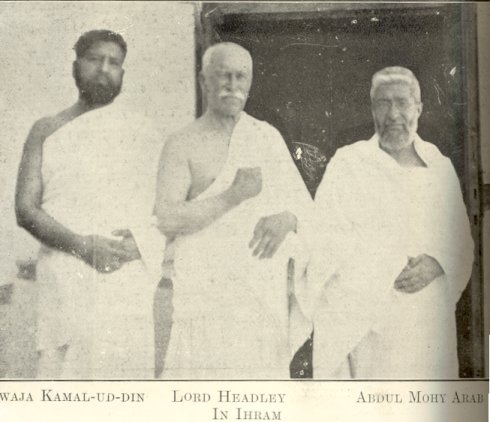
Allanson-Winn With His Great Friend Khwaja Kamal-ud-Din


*** Rowland Allanson-Winn was born in London on January 19th, 1855 and was educated at Westminster and Trinity College, Cambridge, in mathematics. After graduation, he had a range of professions, including (for a time) editor of a regional newspaper in Wiltshire.

However, it was in the early 1890s, when he travelled to Kashmir to become an engineer for the British administration in India, that Allanson-Winn first encountered Islam, in the beautiful, mountainous regions of Kashmir. 

He was, by all accounts, a fascinating, accomplished and open-minded man. A bit of an eccentric in the best sense of the word. One Irish writer described him as 'a man of many parts, a champion middlewight boxer in his day at Cambridge, a distinguished globe-trotter, an editor and excellent raconteur'.

He was also a keen amatuer boxer and one of the earliest exponents of what we know today as "martial arts". In 1890 he co-wrote one of the earliest manuals about self-defence, the classic "Broad-sword And Singlestick", before going on to write one of the first great books about the art of boxing. 

He inherited the title of Baron Of Headly on the death of his cousin in 1913. He could have sat in the House of Lords but did not seek election as an Irish representative. 1913 was also the year that he announced his conversion to Islam, having first encountered the religion in India.

Allanson-Winn had been brought up as a protestant, before studying Roman Catholicism while living in Ireland. But he saw the Christian religions as having what he called a "believe this or be damned" attitude. 

He came to know Islam as a religion of tolerance. 

“It is,” he said on one occasion, “the intolerance of those professing the Christian religion, which more than anything is responsible for my secession. I was reared in the strict and narrow forms of the Low Church party. Later, I lived in many Roman Catholic countries, including Ireland. The intolerance of one sect of Christians towards other sects holding some different form of the same faith, of which I witnessed many instances, disgusted me. …”

A British Peer announcing that he had converted to Islam today would raise some eyebrows (to say the least). We can only imagine what it must have been like in 1913, when the British empire still held sway over millions of Muslims.  

But Allanson-Winn, in his characteristically pugnacious style, made no apologies.

As he said at the time of announcing his conversion (which actually happened in England, after he met Muslims including the Indian lawyer and teacher Khwaja Kamal-ud-Din); 

"It is possible that some of my friends may imagine that I have been influenced by Mohammedans; but it is not the case, for my convictions are solely the outcome of many years of thought. My actual conversations with educated Muslims on the subject of religion only commenced a few weeks ago and need I say that I am overjoyed to find that all my theories and conclusions are entirely in accord with Islam? Even my friend Khwaja Kamal-ud-Din has never tried to influence me in the slightest degree. He has been a veritable living concordance, and has patiently explained and translated portions of the Quran which did not appear quite clear to me and in this respect he showed the true spirit of the Muslim missionary, which is never to force or even to persuade.

He would become a chairman of the British Muslim Society, travel and talk in Muslim communities around the world. And he made the Hajj to Mecca in 1923 (see the photo below).


Allanson-Winn, 5th Baron Headley, was a tireless campaigner for the Islamic faith in Britain and abroad and as he lay on his death bed in England in June, 1935, he scribbled a note to his son, asking that he be buried in a Muslim cemetery; “Means permitting I should like to be buried with my brother Khwaja."

It is easy to see him as an eccentric, in the great tradition of the British aristocracy who travelled the world and often became intoxicated by "Oriental mysticism".

But it seems that nobody who met the man in his life doubted his sincere conviction and his belief in tolerance and the values of other belief-systems. He campaigned tirelessly for Muslims and for understanding between the faiths and wrote several books about the Islamic faith, trying to explain its worth to Christians.

The 5th Baron Headly was a bit of a one-off. 

***** THANKS FOR READING - THERE ARE SOME NEWSPAPER CUTTINGS ABOUT Baron Headly Below***** 


Daily Sketch - 1913

After a career which has included amateur boxing, civil engineering, the editing of a local newspaper, and expert advice on coast erosion, Lord Headley, an Irish Peer, aged 59, became a convert to Mohammedanism.
The conversion was announced at a meeting of the Islamic Society, held at Frascati’s, Oxford street, by the Rev. Khwaja Kamal-ud-Din, who is attached to the Mohammedan mosque at Woking.
“Those who know me will believe I am perfectly sincere in my belief,” wrote Lord Headley in a letter read at the meeting.
Lord Headley may be described as a muscular Mussulman, for when he was at Cambridge he won both the middle-weight and heavy-weight boxing championships. He has written more than one book on the noble art of self-defence. He writes very well, by the way, and has done a good deal of journalistic work in his time. For a couple of years he was editor of the Salisbury Journal.
He has also done a lot of civil engineering in recent years. He superintended some coast defence works at Youghal and similar works on the coast to the north of Bray Harbour. He also did some coast defence works at Glenbeigh, his place in one of the wildest parts of Kerry.
A HAPPY CONVERT
The problem of coast erosion has particularly interested him. At Dover in 1899 he read a paper before the British Association on the history of the reclamation of Romney Marsh.
Lord Headley is a grey-moustached, handsome man, with a fine intellectual forehead and good features, while his habit of smiling when he talks gives him a happy appearance.

Daily Mirror - 1913

IRISH PEER TURNS TO ISLAM
That the lure of Eastern religions is affecting an increasing number of Europeans, is again shown by the announcement that Lord Headley, an Irish peer, who spent many years in India, has become a convert to Islam.
The announcement was made by the Rev. Kamal-ud-Din, who is attached to the Mosque at Woking, at a recent meeting of the Islamic Society.
Lord Headley, the fifth baron, succeeded only last January to the title and estates of 16,000 acres in Kerry.
He was born in London in 1855, and has been distinguished as civil engineer, at one time in India and latterly specially engaged in foreshore protection works.
He is an all-round sportsman, being fond of fishing, rowing, skating, swimming, fencing, shooting and golf. In his youth he won the heavy and middle weights as an amateur boxer at Cambridge University.
Lord Headley has four sons, having being married in 1899 to Teresa, youngest daughter of the late Mr. W.H. Johnson, formerly Governor of Leh and Jumoo.

Tuesday, 2 December 2014

The Ballad Of Lucknow Kavanagh V.C. - Carry On Up The Raj

* I'm returning to one of my favourite themes, here, with the incredible story of "Lucknow Kavanagh" - the Mad Irishman who became an unlikely hero of the Indian Mutiny. And one of only five civilians to win the Victoria Cross. It's a small story and a strange one.

For some men are born heroes. Some have heroism thrust upon them. And a few, like Henry James Kavanagh, seize heroism by the throat and strangle it until it gives in. 

So gather round me, ladies and gentleman, as I bring you the strange tale of Mad Mullingar Man Lucknow Kavanagh....


Thomas Henry  Kavanagh VC - One Of Only Five Civilians To Win The Victoria Cross


Cannon-balls were tearing through the walls of the battered British residency. Outside,some 10,000 rebel native troops of the East India Company were grimly pressing home their attack after five months of siege. 

On the night of November 9th, 1857, with a fifth of the garrison defending what was left of the British stronghold of Lucknow already dead, one man was preparing to go to war. But first, he needed to complete his fancy-dress outfit.

Thomas Henry Kavanagh was about to embark on one of the most unlikely missions in British Military history. And he needed the English officers around him to get over their fits of the giggles.

Perhaps it was the strain of the long siege. 

Maybe it was simply the sight of the grimly determined, six-foot, red-haired civil servant before them in pantomime costume.

But General Sir James Outram, commanding the defence, could hardly keep a straight face.  Some of his subordinates had to leave the room, preferring the risk of being cut in half by a cannon-ball to getting caught, rocking with barely-suppressed laughter. 

It was Sir James himself who was rubbing boot-polish on the face of a lowly civil servant from Co Westmeath in Ireland. The unlikely hero of the hour, James Kavanagh. 

Kavanagh stood before him in the lamplight, dressed in "native garb" as a "hindoo peasant",  grimy robes and a turban, with boot-polish smeared across his face. In a moment, he would try to get beyond the walls and through the lines of rebel troops to reach the stalled relief column. Nobody in the room really expected to see him again. 

Henry Kavanagh was 36 and already the father of nine children when the Indian Mutiny broke out. Living with his family in the northern city of Luknow, he had a dull, low-paid job with the Bengal Civil Service and was resigned, as he said later, to a life of “miserable drudgery”.

And then came the Mutiny. When the native troops employed by the East India company to subjugate an ancient civilisation rose up in rebellion. And Henry Kavanagh suddenly found himself at the centre of Great Events, besieged inside the British Residency with thousands of Europeans, assailed on all side by the "natives" who had risen up to expel the British.


And as it all fell apart about him, as fire, death and destruction swept through the British Raj and the Great Conquerors cowered in their isolated forts, Thomas Kavanagh came alive! What had seemed set to be a life of grey drudgery as a minor clerk in some dusty outpost suddenly became the setting for epic heroism. And Thomas Kavanagh was not about to let his destiny pass him by. 

“I resolved to die in the struggle,” he later wrote, “rather than survive it with no better fame than I took into it.”

Five months into the seige of Lucknow, Kavanagh had been one of its bravest defenders. He had almost had his head taken off by a cannon-ball (the shot burnt his ear), one of his daughters died of dysantry and his wife was shot through the leg.

But Kavanagh had never felt so alive, or "glad to be rid of the restraints of civilisation". The grey civil servant had transformed into a technicoloured hero.

After four months, hopes rose inside Lucknow when word somehow arrived that a relief force was on the way. But that force's commander, Sir Colin Campbell, faced a serious obstacle. How could his small force find a way through the various bands of mutinous troops around Lucknow without having to fight every inch of the way?  One previous attempt had been beaten back with major losses. Without a safe way through the lines, Campbell's Scot's highlanders would face the same fate.

It was Kavanagh himself who came up with the answer. He would disguise himself as a native, find his way through the lines and guide the relief force through on the safest and quickest route. 

Of course, being a six-foot tall, ginger Irishman, he might find it hard to pass himself off as a local. But he convinced the general to let him try, in black-face and improvised costume. 


Kavanagh would not be put off from his suicide mission. "I sat amazed by my boldness" he recalled of the moment.

So off he went into the night, dressed like an extra from an Am-Dram production of The Arabian Nights. 

On the night of November 9, 1857, accompanied by a very brave Indian courier called Kunooujee Lal, Kavanagh slipped outside the walls of the residence. He was armed only with a double-barrelled pistol, one-shot for himself, one for Lal, if they were cornered. 

They blundered around in the dark for many hours, barely evaded capture on a number of occasions and finally made it to the British relief force, more by accident than design, shortly after dawn. 


After getting some reviving brandy and a pair of dry socks, Kavanagh was taken before General Sir Colin Campbell and insisted that the relief column follow him immediately through the safe route to the walls of the British Compound. 


Campbell's force of Highlanders and Sikhs stole into the city, staged a surprise attack on the besieging forces and saved the day. Lucknow Kavanagh was the hero of the hour! 


The Indian Mutiny eventually petered out, after terrible revenge attacks on the now-scattered rebels. In 1860, Kavanagh was presented with the Victoria Cross, a very rare distinction for a civilian and was celebrated throughout the Empire.


However, with the mutiny over, he slipped slowly back into obscurity. Kavanagh stayed with the British Civil Service oversees and died in Gibraltar in 1882, where he was buried.


It's estimated that more than 200 Irishmen have been awarded the Victoria Cross, around 16 per cent of all VC winners, not bad going for a small nation,

Perhaps the strangest VC story of all belongs to Lucknow Kavanagh.


ENDS THANKS FOR READING!

Wednesday, 12 November 2014

1916 And All That - There Will Be Bleurgh!

* A short blog, this, in anticipation of the endless hours of debate, rows, screw-ups, disappointments, recriminations and Thundering Bollixology that will be generated by the 100th Anniversary of the 1916 Rising.

It was announced in the budget that we will be spending €50m quid on this - which is probably around €49m too much. Cynics might say it's just a giant boondoggle for Official Ireland's favourite historians, pundits and arts mandarins - the Artistic-Industrial Complex.

And by the way, if you are not Irish, not much of this is going to make any sense. Having said that, even if you are Irish.......

Truly, we shall ask - Was it for this?


What's that loud noise, we hear rumbling towards us like a Crossly Tender full of vengeful British Tommies!?

Run away! It's the 1916 Centenary Commemorations - or, to give them their proper title....

"The Basterin' 1916 Commemorations Oh Jaysus Christ Are They Ever Going To Shut Up About This Shite?"

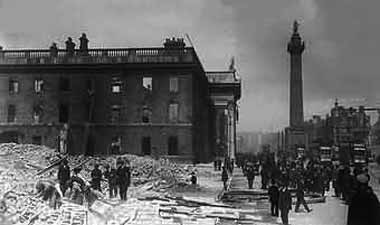
Easter 1916 - The Aftermath


For while we can't say for certain where our crazy little Republic will be by the time Easter 2016 rolls around, we can say one thing without fear of contradiction - by the time we get there, even mentioning the words "Easter" "NineteenSixteen" or "Padraig Pearse" in a pub in Ireland will get you a quick poke in the jaw. And on your way out, a rapid funt up the hole.

Oh God. It's going to happen. We are going to flog this horse to death, re-animate it, flog it some-more and then hang, draw and quarter it outside the GPO. We don't - at official level at least - have the wit or imagination to do anything else.

We won't be able to help ourselves. The Government, our Chattering Classes, our professional People Of Important Thoughts and the History Boys are going to bore the living arses off us with endless, mind-numbing bollix about what this means for modern Ireland, the legacy, the lingering trauma of insurrection and civil war, neighbour-against-neighbour, brother against brother and fish-monger against plumber.

"Ye Stay Here Lads, I'll, er, Cover Ye From The Biscuit Factory. For three days"
We'll overdo it. Because we feel we have to give it the full nine yards. It was quite an event after all. And sure didn't the Brits do a great job on commemorating WWI? We'll just have a look at what they did and bob's yer uncle.

Get Macnas on the phone, somebody feed seven gallons of RedBull into Diarmuid Ferriter and for God sakes make sure Fintan O'Toole is kept sedated because we are going to need him before this campaign is over.

And get me a Bowman. Two if you can find them.

The poor people of Ireland will be battered into submission by endless books, think-pieces, docs, analysis, dodgy recreations and protestors standing outside the Dail with badly drawn signs asking "Was It For This, That Connie Markevic Gave His Life?"

Meanwhile, the Gov will try to make it some inspiring celebration of cultural diversity and inspiration and togetherness and...er..do you think we can get a couple of quid out of Google to cover the sandwiches?

They already have a hashtag and everything! #IrelandInspires ! And if that don't inspire you to write a letter to Queen Liz II, asking for readmission, nothing will.

And for what? What was 1916 but an ill-thought out military farce, run by a rag-bag of poets, socialists, religious nutters, arch-conservatives, heroes, zeroes, fools, patriots and a few people who happened to wander in to the GPO in search of a postage stamp and ended up fighting the British Empire, by mistake?

It was the latest in a long line of glorious failures. But it succeeded. Kinda, sorta. And only after another two awful wars and the long drawn out insanity of The Troubles.

For the 50th anniversary, there was a big military parade down O'Connell Street, a few speeches and the traditional Rounding Up And Jailing Of The Fallen Women (always a popular one, that) and we just left it at that.

So what should we do this time around? Well, if you were asking me (and nobody in their right mind would) there are plenty of great stories around 1916 that fully deserve to be told. Not the usual guff about Padraig Pearse and the precious blood of Irish patriots - or what 1916 "means" to Ireland 2016 (Feck All) - but the stories of actual human beings of all shades and denominations.

And for the Big Stuff - Do a parade on the weekend in question - get our soldiers who have served with honour with the United Nations to march. Get the Orange Order down (why not, they were a part of the times too and they've loads of experience with parades).

Have an interdenominational service. Fly the flags at half mast. And maybe ask what happened to the ideals and the vision of Ireland held by people like James Connolly. And Michael Collins (blessed be his name).

And forget this touchy-feely, expensive YouTube ad campaign #IrelandInspires bollix. Because that's the fake stuff. The ersatz, Best Little Country In the World shite that fools nobody. Not even the tired cynics and marketing men who are paid ridiculous amounts of money to throw it together. Especially not them.

Commemorate all of the men who died, yes, the Tommys too, because most of them were just kids from the slums of London, Liverpool, Newcastle and Glasgow.

And maybe do one more thing - do a national essay competition (written, audio or video) for every school-kid in Ireland. Ask them what Ireland means to them and what they want for their future.

Because I can tell you one thing now - it ain't a jaded, cynical social media campaign that says #IrelandInspires.

* hey! Thanks for reading, and don't worry, I'm not off my meds.


Wednesday, 29 October 2014

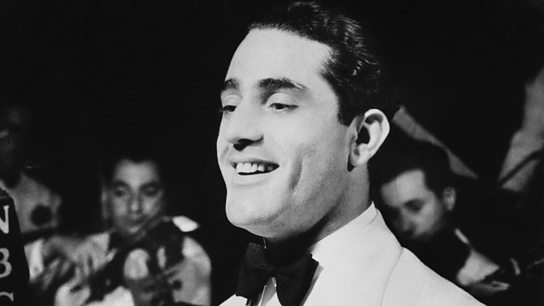
Love Is, The Sweetest Thing - Al Bowlly - Wrote Hits, Died In The Blitz

** Of all the musical styles of the 20th century, the classic ballroom crooning of the inter-war period is perhaps the most forgotten and the least likely to be revived. As a style, it is perhaps too mannered, too much of its time and, to be blunt, too strange and campy for modern ears.

However, one crooner from the '20s and '30s who deserves to be remembered (but is now largely forgotten) is the great, the tragic Al Bowlly. I personally love his music, perhaps for its other-worldly sweetness, innocence and sincerity. These are not qualities you associate with most contemporary music.

Bowlly not only crooned the lightly jazz-inflected, romantic songs that your grandparents loved and danced to, he also wrote some of the most memorable tunes of the 20th Century.

He had a brief yet blazing career at the top. And then was killed at the height of the London Blitz. So I thought I would share his story and celebrate his genius in a small way.

As another performer and songwriter, Richard Thompson, sings, Al Bowlly's In Heaven.

The Sweetest Thing - The Incomparable Al Bowlly 


***When Stanley Kubrick went in search of music for the chilling ballroom scene in The Shining - where frustrated writer and Dad Of The Year candidate Jack Torrence enjoys a bourbon-on-the-rocks surrounded by spectral ballroom dancers, he went to his '20s musical adviser John Wadley.

What Wadley brought him was a 1934 recording of "Moonlight, The Stars And You", featuring the voice of a long forgotten crooner called Al Bowlly backed by The Ray Noble Orchestra.

Kubrick brilliantly used the sweet and innocent sentiments of this syrupy ballroom song as a contrast to the increasing psychosis of Jack Torrence. It is, of course, a very chilling, unsettling scene.


And it is Al Bowlly's voice we hear as the tuxedoed barman tells Jack; "Your money is no good here....orders from the house".

Even by the time the recording was made in 1934, Bowlly's style of singing was beginning to go out of fashion. The brassier, hipper, more high-octane sound of American big band Swing era, led by the likes of Glen Miller, Count Basie and Benny Goodman, was about to sweep the old crooners away.

Bowlly was born in Mozambique (to Greek and Lebanese parents) and grew up in South Africa, where he first became a professional singer with the big bands of the day,

As a young man in South Africa, he worked odd-jobs as a barber and a jockey before taking off on an eccentric trek around South Asia, singing in ballrooms, working on tramp steamers and even busking in restaurants and bars to keep body and soul together. He was the resident crooner in the ballroom of the Raffles hotel in Singapore, delivering the "Moon & June" melodies of the era as up-country planters and their wives fox-trotted between the potted palms in the tropical night.

When he eventually washed up in London (he almost didn't make it after gambling away the fare that had been lent to him by a band-leader) Bowlly, with his syrupy voice, dark good looks and dapper style, became a hit, one of the biggest stars of the dance-band era. He had success in the UK, America and on the continent, selling huge amounts of sheet-music (the singles of the day) and popularising many 20th Century classics.


Billed as "Al Bowlly - The Ambassador of Song", his concerts from venues such as the Monseigneur Restaurant in London were broadcast live to millions of enchanted radio listeners, his slightly other-worldly, echo-heavy voice pouring out of illuminated-dial valve-radios in homes across Britain.

Bowlly also tasted success in the US, and for a very brief time, was one of the highest paid vocalists in the business, a serious rival to Bing Crosby.

He recorded between 500 and 1,000 songs (some are lost) and either co-wrote or popularised such classics as "Blue Moon", "Easy To Love", "I've Got You Under My Skin", "The Very Thought Of You" and "My Melancholy Baby". Such was his success, Bowlly was given his own radio show on NBC and went to Hollywood to co-star with Bing Crosby in The Big Broadcast".

However, Bowlly's unwillingness to stay in one place or with one band, together with problems with his vocal chords, led him to return first to London, then South Africa, hoping that the change in climate would do him well.

He lost his voice for long periods, fritted away his money and had to borrow cash to pay for a voice-saving operation in New York in 1938.

My favourite Bowlly song is the one written by his regular band leader Ray Nobel in 1932 and made popular by the man himself, the sublime "Love Is The Sweetest Thing".


Bowlly's first marriage, in 1931, ended on his wedding night, when he found his new bride in bed with another man.

He married again just before the Second World War, when his career was seriously on the slide and he was playing regional ballrooms and restaurants in England, in a bid to pay the bills.

On April 17th, 1941, Bowlly had just given a performance at the Rex Cinema in Oxford Street, High Wycombe, when he decided to turn down the chance to stay locally and get a late train back to his flat on Duke Street, St James, London.

The decision proved fatal. Bowlly's apartment was destroyed by a Luftwaffe parachute mine that detonated on the street outside during a raid in the early hours of the morning. The bomb blew the door of his bedroom off its hinges and the impact of the door on his head killed him instantly.

There was not much notice of his death, not at a time when hundreds of people were being killed every night by the Luftwaffe. Bowlly was quickly buried, along with other Blitz victims, in a mass grave at Hanwell Cemetery.

By the time he had died, the era of the big band crooners had already come to an end. The sweet, sentimental dance music may not have been in step with the furious energy and tension of the war-time years. In the post war years and on into today, you rarely hear his name or his voice.

But Al has left a rich legacy of song and his voice echoes occasionally in popular culture.

He was a more natural performer than most of the crooners, with an easy style and a laidback phrasing that foreshadowed the later style of singing embodied by Sinatra.

You can get a lovley sense of his style and persona here, on Melancholy Baby....

One of my favourite mentions of Al in recent years came in a very overlooked British Movie, I Really Hate My Job, with the great actor Danny Houston delivering a cameo as a ghostly crooner.

Houston's performance is sweet, slightly strange and other-worldly. Just like the voice of the great Al Bowlly.


.
* Thanks for reading.