Monday, 12 May 2014

Sir Hugh Gough - Ireland's Opium Warlord & The Subjugation of China

* Bit of a long read, this - a cut-down of a chapter in my book, Murder, Mutiny & Mayhem, The Blackest Hearted Villains from Irish History....(still available from Amazon/actual bookstores, buy one. You won't regret it).

It's about an Irish soldier who successfully invaded China and started the long process of the end of the Emperors. All in the name of selling vast amounts of narcotics at the behest of the British Government & Financiers in the City Of London - globalised, Government drug dealing in the Victorian era....

Forget the War On Drugs, this was the War For Drugs, known to historians as The Opium Wars.... 

Limerick Man Sir Hugh Gough - With Supplicant Natives


It is hardly an honour for Limerick. But the Treaty City can lay claim to the most ruthless, brutal and successful Drug Lord in history. And also the most decorated and respected.

Sir Hugh Gough was much more than just the mid-19th century Pablo Escobar. While modern international criminals work in the shadows, Sir Hugh had the blessing of Queen Victoria and her government and operated with flags flying and marching bands playing.

And unlike the Mexican cartels or the Columbian cocaine Kings, Sir Hugh and his backers thought big.China big.

It was globalisation by gun-boat and nothing less than the deliberate enslaving of millions of people to drug addiction and the ruin of an ancient empire. For profit.

It seems incredible to us now that a military and commercial superpower would fight a major war to force a country the size of China to accept a massive and officially sanctioned narcotics trade, especially at a time when the United States of America and other countries are involved in an global War on Drugs.

But that is exactly what the British did in the mid-19th century. In fact, they fought two Opium Wars. And Limerick's General Sir Hugh Gough commanded the British forces in the first. It would result in humiliation and degradation for an ancient kingdom, the enslavement of millions to opium addiction and a treaty which included the ceding of Hong as a long-term British trading base.

And Sir Hugh had a profitable career - the building that is now the Radisson Hotel in Stillorgan, Dublin, was the stately house he built for his retirement.

The aim of the British commercial interests in 1839 was to force the Heavenly Middle Kingdom of China to allow annual shipments of tonnes of narcotics. And because the Chinese had tried to resist the trade - it would be enforced at the point of a bayonet.

The infamous trade had been going on for decades. In 1820, just to take one year, some 900 tonnes of Indian opium were brought by British trading ships of the East India Company to China. And by the height of the trade there were an estimated 12 million addicts.

As well as narcotics, the British (along with the French and other colonial powers) also wanted to force the Chinese to open their vast markets up to European textiles, technology and trade goods, while emptying their treasuries to pay. Then, as today, there was a trade imbalance problem between East and West. But in the mid-19th century, guns and drugs were the means by which the scales would be balanced.

And when the Chinese tried to resist the opium trade and push back against European commercial rapacity, Sir Hugh Gough's forces were the hammer that would smash all resistance and open up the vast kingdom to the hugely profitable imperial British drug trade.

British flintlocks and Royal Navy gunboats (an innovation of the Opium Wars) would clear the road for British commerce.

And it wasn't as if the British government didn't know what it was doing.

At the conclusion of the First Opium War in 1842, a newly elected MP called William Ewart Gladstone (who would go on to be one of the greatest statesmen of the age) asked if there had ever been "a war more unjust in its origin, a war more calculated to cover this country with permanent disgrace."

However, the then Foreign Secretary, Lord Palmerston put the upstart MP in his place by pointing out that nobody "could say that he honestly believed the motive of the Chinese Government to have been the promotion of moral habits" and declared that the war was merely a trade dispute, fought to stem China's balance of payments deficit.
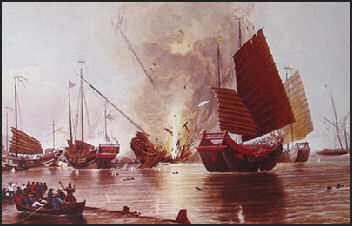

Chinese Junks Under British Naval Fire


There was profit to be had. And an empire to be built. Gough's dirty war would also lead directly to the founding of Hong Kong, the corner stone of of British commerce in the Far East for a century and a half.

For the Chinese, it would result in the military humiliation and eventual disintegration of an ancient empire. They still call it their Century of Humiliation.

It meant the addiction of millions of Chinese people, of all walks to life, to opium.

The trade also led to decades of decay and economic and political chaos, what the Chinese call “Hundun” or “primordial chaos”, from which the country has only recently started to recover.

If we want to understand modern China, its nationalism and its attitudes to the West, we should start, perhaps, with the Opium Wars.

Limerick's Sir Hugh Gough, a hugely successful and decorated career soldier, may have only been the instrument of ruthless international trade, one of the many soldiers at the sharp end of the vast colonial and commercial project.

But if the Chinese have good reason to hold a grudge against the British, there must be a small part of the national psyche that still remembers a son of Limerick with a special hatred.


Hugh Gough was a son of solid Anglo-Irish stock, born on the outskirts of Limerick City on November 3rd, 1779.

His forebears were pillars of the Anglo-Irish community from their arrival in Ireland during the reign of King James I, counting Bishops , barristers, High Sheriffs and militia colonels amongst their number.

Sir Hugh's father was Lieutenant Colonel George Gough, who commanded the Limerick City militia in putting down the local United Irishmen of the 1798 rebellion and fought the French and Irish forces at Westport and Johnstown.

Hugh, one of six children of George Gough and Letitia Bunbury, won his commission into the British army at the age of thirteen and began a military career which was to last most of his life and be blessed by spectacular successes.

Sir Hugh was said to have never lost a significant battle, won four colonial wars and commanded at more major engagements than any other British officer of the 19th century bar the Duke of Wellington, victor of Waterloo.

His military career would take him all over the world, fighting for the interests of the British Empire in Spain, Portugal, Africa, the West Indies, India and China.

He was brave, often to the point of recklessness, leading almost always from the front and usually limiting his tactics to the shock and awe of frontal assault, especially against less well-trained and well-armed “native” forces.

Military historians and his contemporary generals have tended to dismiss Gough (perhaps unfairly given his record) as a poor strategist and inept tactician.
However, Napoleon was famously said to have asked of any officer he was considering of promoting to General; “Is he lucky?” And in the case of Sir Hugh Gough, who fought and routed l'Empereur'sforces in the Peninsular Wars, the answer would have been very much in the affirmative.
In an age when military commanders were supposed to have dash, élan and an almost insane disregard for their own personal safety, Sir Hugh Gough and his enormous mutton-chops would always be front and centre in the line of battle, showing a steely contempt for the perils of the battlefield.
At the Battle of Sobraon in 1846, during the First Sikh War, when told that his troops were running short of ammunition, Sir Hugh was heard to mutter, “Thank God! Then I'll be at them with the bayonet.”
He survived horses being shot out from under him and bullet wounds in Portugal, shrapnel tearing through his uniform in India and the best efforts of opposing armies on three continents.
During the Battle of Ferozeshan, again in the First Sikh War, his infantry was being mown down in rows by heavy cannon fire (the British had trained the Sikhs, ferocious fighters they valued as a “martial race”, as expert gunners).
Gough, deciding he needed a diversion to draw the enemy fire away from his troops, began galloping across the enemy front, dressed in his famous white ‘fighting coat.’
The Sikh gunners recognised the General, opened fire and missed. Gough won the battle. It was hardly a textbook stratagem but it was in keeping with his general “Have at 'em, lads!” approach to warfare.
It was war and it was often bloody slaughter. And if that meant suppressing slave rebellions in the West Indies, putting thousands of rebellious Sikhs to the sword (in their own country, naturally) or forcing opium down the throats of the Chinese at the point of a 24-inch bayonet, Sir Hugh had his orders and he wasn't going to let sentiment get in the way.

His long, varied and world-ranging military career (including duty in Ireland in 1829 suppressing outrages) reflected the global ambitious of the rapidly expanding British Empire from the end of the 18th century onwards.

The Peninsular Wars had made him and his Indian campaigns were the crown on his career. But it was China that would confirm Gough as one of the most successful soldiers of his era.

The First Opium War (1839-1842) was the inevitable result of decades of growing tensions between European colonial interests and the weak and isolated Qing Dynasty of China. The Portugese, Spanish and then the British and other european powers had been trying to force their way into China since the late 1500s.

The Chinese were wary of trade with the barbarians from the West and tried various means to halt the spread of western trade, technology and influence in the Heavenly Middle Kingdom.

By the middle of the 18th century, it was the British East India Company, with a royal charter to trade with China, that began to dominate, using private armies and navies to snuff out opposition and keep reluctant regional rulers in line.

But the British faced a major trade deficit. They wanted tea, porcelain, silks. The Chinese only wanted silver - the hard currency of the era. 

By 1800, the East India Company was buying 23 million pounds of tea per year, at a cost of 3.6 million pounds of silver.

The Chinese would only accept payment in silver, the hard currency of the period.

This put the British, who were on the gold standard, at a particular disadvantage as they had to buy silver from other European powers and Mexico to pay the Chinese.

The British needed to find a trade good that was easy to source and produce, easy to transport and prove to be as irresistible to the Chinese as tea was to them.

And in the early 18th century, despite vehement protests from the Qing rulers, British traders began importing opium from India.

For the British, it was the perfect solution to the trade deficit problem. There was an instant mass market for their cheap Indian opium. And millions of loyal, addicted customers would reverse the flow of silver from East to West.

The Chinese were horrified and began a long and unsuccessful campaign to ban the narcotic that was turning vast numbers of their people into addicts. Emperor Yongzheng had banned the sale and smoking of opium as early as 1729 (small amounts were allowed to be imported for medicinal use).

As the scale of the problem increased, desperate officials made the trafficking of opium punishable by death.

But as many governments since have found, prohibition and crackdowns, no matter how severe, have little to no effect on the distribution and consumption of drugs. Especially if that trade is enthusiastically sanctioned by the most powerful nation on the planet and backed by British men-o-war.

The opium trade multiplied, the narcotic came by the tonne from Bengal in the holds of British Indiamen (the East India Company had been granted a monopoly on the trade by the British crown) the silver reserves of China went west and the mandarins were powerless to stop it.

The Qing government, isolated in Beijing, could not control the southern ports. By the 1820s, China was importing 900 tonnes of Bengali opium every year. There were an estimated 12 million addicts. It meant untold human misery, the beggaring of an Empire.

In March 1839, the Chinese reached their breaking point. One of the Emperor's own sons had died from an overdose. An official called Lin Tse-Hsu was despatched to Canton to shut down the opium trade. When the British merchants refused to co-operate, Lin Tse-Hsu ordered the forcible seizing opium supplies in the Cantons and the boarding of British ships bound for the treaty ports.


Lin Tse-Hsu - He Wrote To Queen Victoria


Lin, regarded as an official of great integrity and energy by the Emperor Daoguang (or Tao-kuang as he was known in the West) had previously set up addiction treatment centres around the areas worst affected by opium addiction.

Mindful of the powerful financial interests in the opium trade in London, the Qing government, through Lin Tse-Hsu, took the highly unusual step of publishing an open letter to Queen Victoria, appealing to her moral judgement and asking how her country could profit from such as terrible trade (Queen Victoria herself was one of many British people who regularly used opium as a medicinal aid, it was not illegal in Great Britain at the time but its use was mostly controlled).

The letter stated; "Your Majesty has not before been thus officially notified, and you may plead ignorance of the severity of our laws, but I now give my assurance that we mean to cut this harmful drug forever."

The Chinese moved to seize opium ships in their ports. And that was enough for the British East India Company, the Government and the money men in the City of London. 

After a series of skirmishes at sea involving local British squadrons and some diplomatic playing for time by the Chinese, a large British Indian Army and naval force was despatched to southern China in June 1840.

Sir Hugh Gough went in with a major naval force and the hopelessly outgunned Chinese could not resist for long. Within months, with the British threatening to cut grain shipments to the capital and plunge the country into a disastrous famine, the Chinese capitulated and agreed to a ridiculously one-sided treaty, giving the British everything they wanted including Hong Kong.  


Chinese Depiction of an Opium War Battle


On January 26th, 1841, a separate force under Commodore Gordon Brenner led a contingent of naval men ashore at Hong Kong to claim the island for Britain – it would remain in British hands until 1997.

It was the first of a series of agreements with the Western trading nations, later called by the Chinese the "Unequal Treaties."

For the Chinese, it was the start of what they would call a century of “national humiliations”, more foreign incursions, forced trade, domestic chaos and the ever-present blight of opium.

For Limerick's General Sir Hugh Gough, China was just another campaign in another far-flung, exotic corner of the world.

ENDS

Wednesday, 7 May 2014

The Lost Art of Victorian Glass Plate Photography - Loved by James Joyce, Revived In Dublin by a Roman


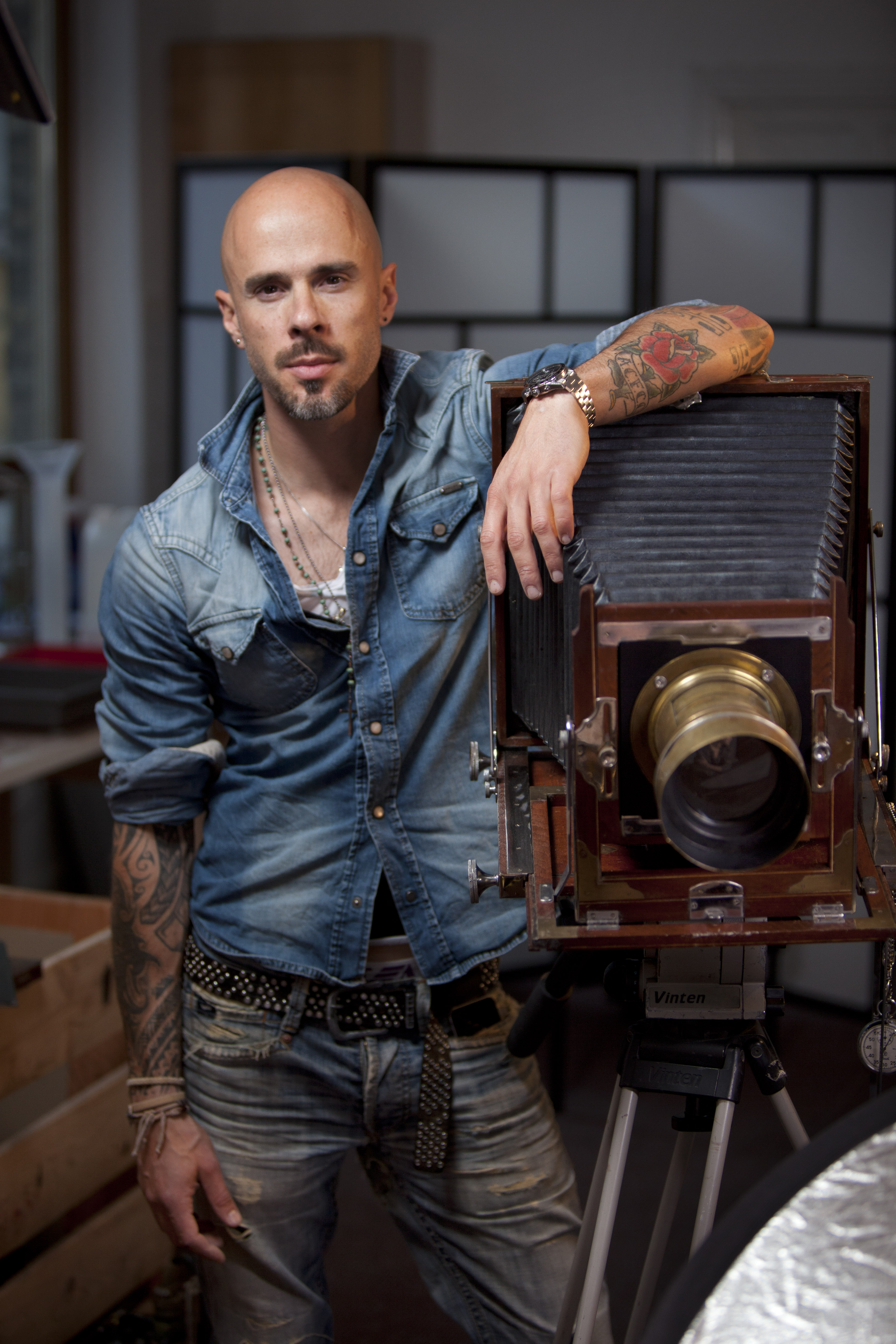
* You'll have to excuse the vanity here, below is a photo taken of myself recently by Alex Sapienza, a photographer and documentary camera-man, a good friend of mine who has put a lot of his heart & soul into what might seem like a quixotic, if not anachronistic crusade, reviving the mid-Victorian photographic techniques of tintype and glass-plate...so I wanted to write a bit about Alex and the history of his art....(and it is art)


Pic of Yours Truly - by Alex Sapienza 


* In the first Golden Age of Portrait Photography, the great writers, explorers, statesmen and aristocrats of Europe and the world knew that true art took that little bit of time.

The Wet-plate Collodion process required a few moments of stillness from the subject and a minute or so in the hands of the artist before the shades of dark and light resolved themselves to form something special.

And in this age of Smartphones and Instagram, it is easy to forget how taking photographs, and portrait photographs in particular, was once a highly involved, meticulous and mercurial art.

Point-and-click photography allows us to create hundreds, even thousands of images which are digitised and disposable, gathering virtual dust in discarded digi-cameras, phones or PCs. It's estimated that around 95 per cent of all the photographic images made in history have been created in the past four years. It's not so much a revolution as starting from Ground Zero.

Which brings us to Alex Sapienza and The Analogue Studio on South William Street in Dublin, and his travels back through time.

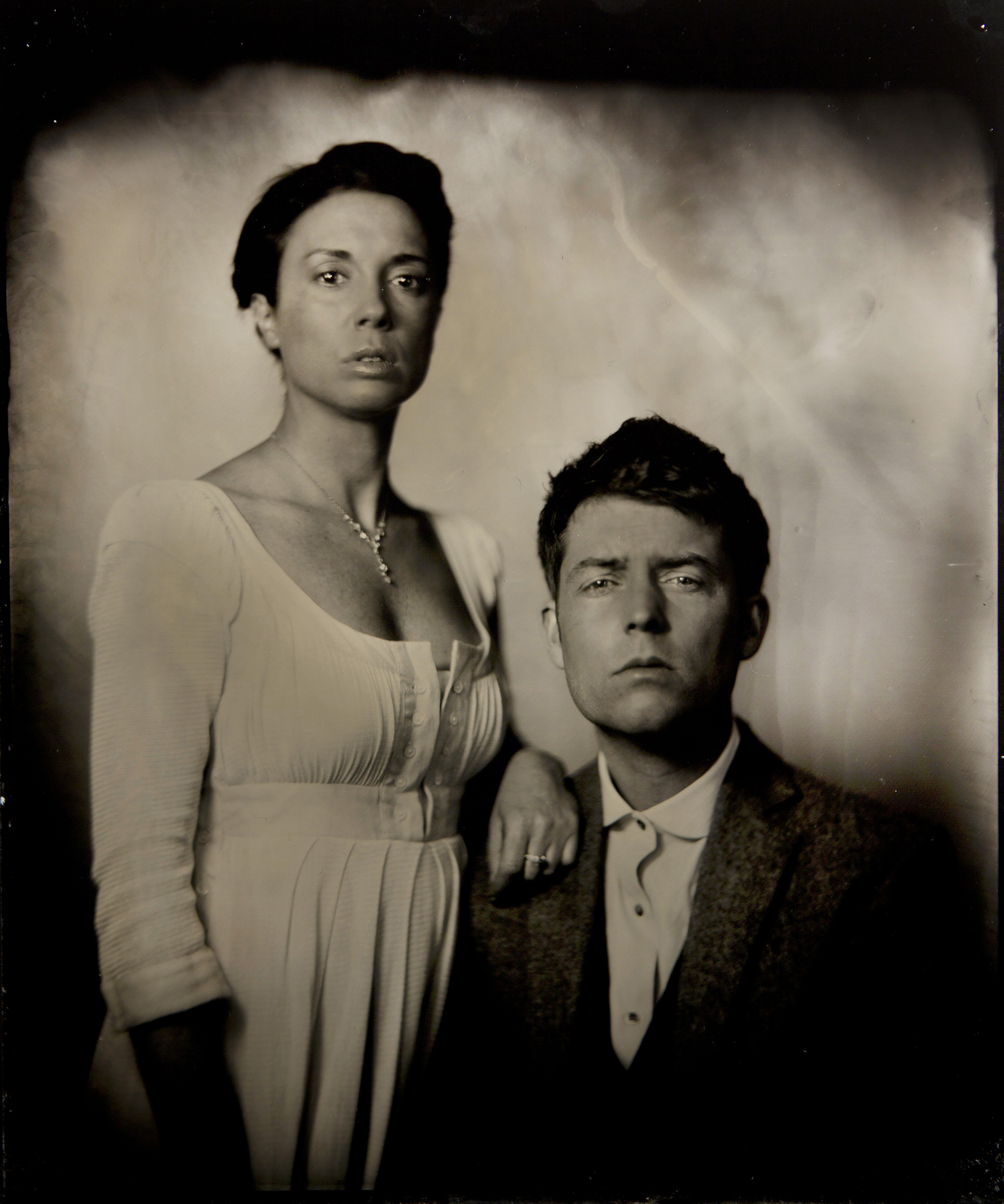
Wedding Portrait - Recently Taken At the Analogue Studio


Alex, originally from Rome but now pretty much Irish, set up his studio almost a year ago, setting himself the task of resurrecting the almost lost art of tin-type portraiture, faithfully using the (occasionally potentially lethal) chemical processes and techniques of the 19th century.


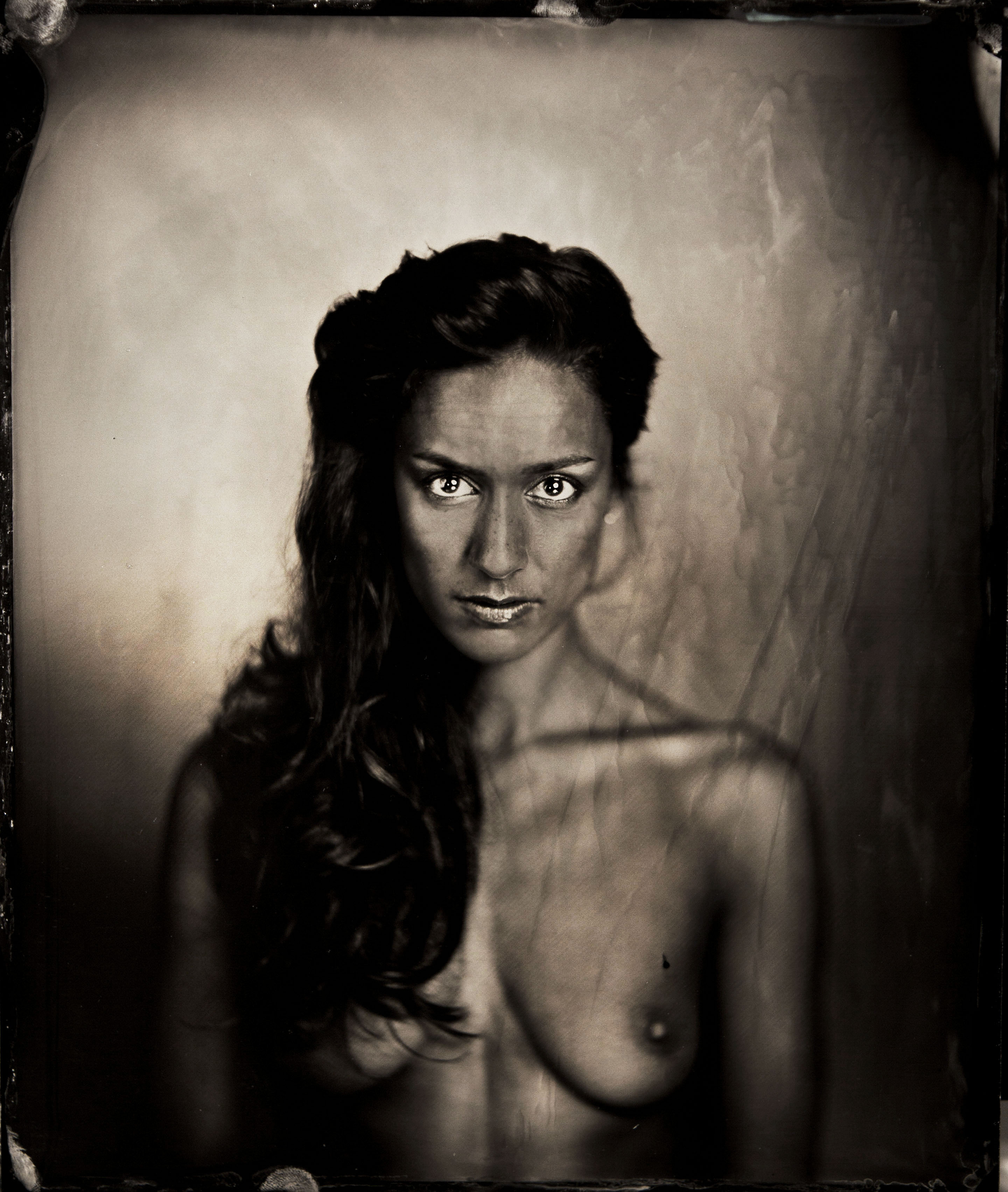
He has immersed himself in the arcane art of long-exposure, glass-plate and silver-nitrate, exposing the image for several seconds onto a large glass plate, dipping the plate into a chemical bath (chems include arsenic, not easy stuff to handle) and then using liquid silver to print the image. 


Dubliner (And Roamin' Roman) Alex With His 120yr old Camera


Alex has resurrected the techniques last used in Dublin when James Joyce was sitting for his iconic, first portrait as an artist. And earlier, when he was just an six year old boy in a sailor suit.


Hello Sailor - Joyce in 1888


Joyce in fact wrote about the famous Dublin portrait photographer, James Lafayette, in Ulysses, referring to the glass-plate process in poetic terms, noting how “...the inspired pencil of Lafayette has limned for ages yet to come”.

Lafayette photographed the British royal family and the greatest Irishmen and women of the age. But the coming of the Kodak camera saw glass-plate superseded by new techniques.

When his studios finally closed in the early 1950s, thousands of his unique glass-plate negatives were sold off to be used in suburban glass-houses. For years afterwards, visitors to suburban Dublin gardens would see ghostly Victorian faces peering from underneath the moss and rain-drops.

Now, after almost 100 years, commercial glass-plate portrait photography is making a return to Dublin. 

Alex in the the Analogue Studio offers clients the chance to sit for a unique, hand-developed photograph on glass or aluminium panel.

After your sitting, you can watch as the image appears magically on the glass plate (one of the differences with wet-plate is that the image develops in the light, not in a dark-room). 

I think the technique captures something that you won't see in a lot of modern photography - especially camera-phone snaps - the fact that the face must remain still for three,four or five seconds means that you will see something of the soul at rest.

You can visit the home-page of The Analogue Studio Here

And here's a short vid in which Alex explains the entire process.... it's well worth a look.


Alex is always happy to get new commissions - if you are interested in getting a unique portrait of yourself or for friends, or just finding out more, I would urge you to get in touch.....

ENDS


Tuesday, 6 May 2014

Wrong-Way Corrigan & Mad Tommy Fitz - Backwards Across The Atlantic & Landing Stolen Planes In Uptown Manhattan


* I've always liked the story of Douglas "Wrong Way" Corrigan - the Irish American aviator who flew backwards into worldwide fame in the '30s. Just recently, I've also come across a more obscure tale of Irish daring-do in the sky - the strange legend of serial aeroplane thief and terror of the Manhattan Skies - Mad Tommy Fitzpatrick....... 

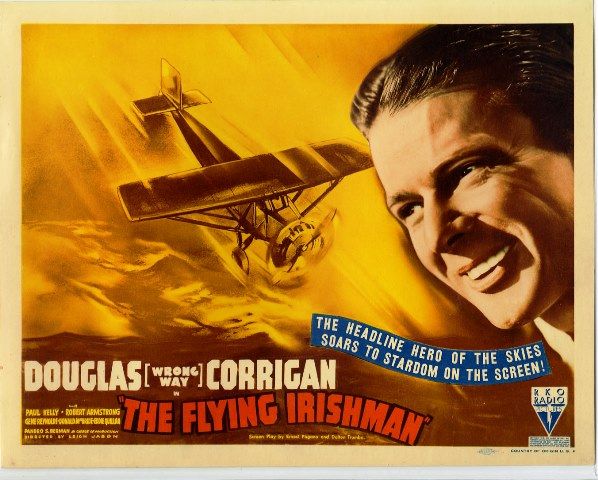
Wrong Way Makes a Movie 


WB Yeats may have written one of the greatest poems about aviation in An Irish Airman Foresees His Death.

But even auld Willie would have struggled to do justice to the legends of bonkers aviation heroes Douglas "Wrong-Way" Corrigan and Mad Tommy Fitzpatrick, two Irish-American pilots who took to the skies with a sense of adventure and illegality. 

Corrigan was by far the most famous - flying solo across the Atlantic "by mistake" in a tiny plane in 1938 (it later emerged that there may have been some method to his madness). Corrigan left New York with a flight plan for Los Angeles, only to end up two days later in Dublin, eventually returning back to New York for a ticker-tape parade down 5th Avenue.

Tommy Fitz was not so well-known, he just liked to make drunken barroom bets involving stolen planes and madcap landings on Manhattan avenues. 

For our first Hero of the Skies, Corrigan, it all started at 5:15 in the morning on July 17, 1938, when the then 31-year-old aviator walked out onto the tarmac of an airfield in Brooklyn, New York, climbed into the cockpit of his plane, and made for the skies, bound for Los Angeles.
It was the days before civil radar systems and pilots would use a mix of dead-reckoning (using maps, visual markers and complicated sums involving airspeed & wind) to make out where they were going. They also radioed in regularly to check their position. Aviation was a decidedly seat-of-the-pants affair, sometimes dangerous and always unpredictable. Fog, for instance, could be fatal and it was not uncommon for pilots to drift way off course and never be heard from again.
Even so, observers were more than a little surprised when Corrigan’s plane banked sharply to the east on takeoff and disappeared into a looming cloudbank over the Atlantic Ocean, the exact opposite direction of where he was supposed to be headed. They were even more surprised when reports came in, 28 hours and 13 minutes later, that Corrigan had landed his little modified Curtiss Robin monoplane at an airfield outside Dublin, Ireland, and amiably told the workers who gathered around him, “I just got in from New York. Where am I? I intended to fly to California.”
Thus was the Legend of Wrong Way Corrigan born (the newspaper man who came up with that nickname probably got a few drinks that night) and the genial Irishman became an overnight, international sensation. 
It was a little over ten years since Charles Lindbergh made the first solo crossing of the Atlantic in the Spirit Of St Louis. And by any measure, Corrigan's journey in a jury-rigged, single-engined plane was just as miraculous. He was either brilliantly skilled or brilliantly lucky. Maybe both.
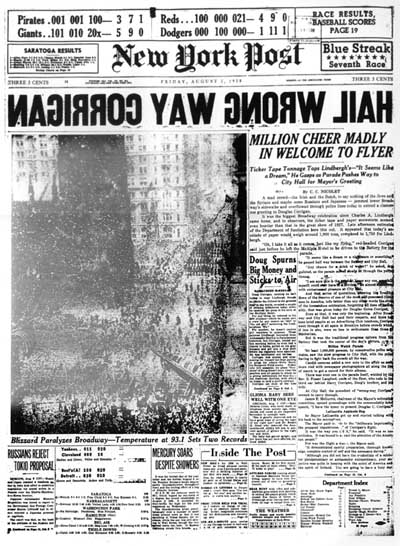
Corrigan's easy charm and modest "aw shucks" demeanor endeared him to a world looking for heroes and the newspapers and newsreels went nuts (check out the clever backward headline in The New York Post - celebrating Wrong Way's epic, backwards achievement).
The New York Post Salutes Wrong Way Corrigan - With A Backward Headline 

Corrigan swore blind that it had been a simple mistake - he meant to fly west but got turned around in the fog and headed east to his ancestral homeland instead. 
With a bit of Blarney, he told how he had been betrayed by a faulty compass and absentmindedly wandered off to Ireland without ever bothering to check the lay of the land below him.
However, it later emerged that Wrong Way - after crossing the US in his (almost) home-made plane (bought for €310 dollars and modified by himself) - had applied several times for permission to fly solo across the Atlantic.
The civil aviation authorities took one look at his just-about-held-together aircraft and said no. Corrigan had cobbled together his own, dangerously overpowered engine from two old ones. It was so big, he couldn't see out of the cockpit.  His door was held in place by bailing wire. There was no way they were going to let this maniac fly across the Atlantic in THAT.

Corrigan And His Plane

But the former barnstormer & cropduster was determined. He had actually help build Lindbergh's Spirit of St Louis and pulled the chocks out from the wheels before it taxied off into history on May 20th, 1927.
He had already applied several times for permission to fly the Atlantic in his own ship. And if the authorities wouldn't give him permission, well, he could always blame a faulty compass. 
Strangely, his story of flying solo across the Pond by mistake caught the public's imagination and made him more famous than he could ever have hoped to have been just for flying the "right" way. 
Corrigan knew exactly what he was doing as he headed off into the clouds over Brooklyn. And in the bargain, he set a new record, despite a leaky fuel line that made the crossing even more perilous than it already was. The American public winked along with Corrigan. He earned a tickertape parade in New York, public appearances, a book deal, a movie contract, and a few celebrity endorsements, including one for a pocket watch that ran backward.
By the time World War II began, the commotion surrounding him had quieted, and Corrigan worked as a test pilot and freight transporter. He later bought an orange grove outside Los Angeles. He was all but forgotten afterward, and when he was invited to display his famed plane at an aircraft show in 1988, he grumbled that he would take him a lot of work to do so—he had taken it apart and had been storing it in his garage since 1940.
Toward the end of his life, Douglas Corrigan is said to have quietly admitted that his trip hadn’t been a wrong-way adventure after all. However, even in his last months—he died on December 9, 1995, at the age of 88—Corrigan never said anything other than that fog and a bad compass had been kind enough to give him a small measure of fame in his day.

*****Corrigan's slightly crazier descendent was Tommy "The Mad Marine" Fitzpatrick, the Airborne Terror Of Manhattan.

The bould Tommy, an Irish-American veteran of the Korean war, pulled off what ranks as two of the most spectacular barroom bets off all time - in the '50s.

In 1956 and again in 1958, Tommy twice rose from his barstool in Washington Heights, New York, announced he would be back shortly, and disappeared off into the night (and New Jersey) to find a plane. On both occasions, he hot-wired the aircraft, took off and piloted them towards the bars he had recently been drinking in. Landing on city streets amidst the canyons of Manhattan and nonchalantly taxiing up to the door of the bar.

At 3am on September 28th, 1956, he stole a a plane from a New Jersey airport and landed it on St. Nicholas Avenue in northern Manhattan, in front of the bar where he had just been drinking.


Tommy Fitz wins his bet - the plane he landed in Manhattan


And just to prove that was no fluke - Mad Tommy did almost the exact same thing two years later. 
Both landings were pulled off in incredibly narrow landing areas, in the dark – and after a night of hard drinking in Washington Heights taverns.
Both times ended with Mr. Fitzpatrick charged with wrongdoing. The second time around, he was jailed for six months by an exasperated judge.

It Was Right Where I Parked It - Tommy's Plane - Bar on Left

The first of his flights started in a stolen, single engined plane at he Teterboro School of Aeronautics in New Jersey. Tommy took off without lights or radio contact and landed on St. Nicholas Avenue near 191st Street.
The New York Times called it a “fine landing” and reported that it had been widely called “a feat of aeronautics.” He got off with a small fine.
The second flight was on Oct. 4, 1958, just before 1 a.m.
Again he took a plane from Teterboro and this time landed on Amsterdam & 187th Street in front of a Yeshiva University building after having “come down like a marauder from the skies,” in the words of judge at the subsequent trial. Newspapers reported that Mr. Fitzpatrick jumped out of the landed plane wearing a gray suit and fled, but later turned himself in.
Mr. Fitzpatrick told the police that he had pulled off the second flight after a fellow drinker refused to believe he had done the first one. Perfectly reasonable, really.
That first flight, Mr. Fitzpatrick later admitted, was the result of a barroom bet. He had wagered with a fellow drinker that he could leave the bar, go to New Jersey, and then get back in 15 minutes. And he did.
Tommy died in 2009 at the age of 79, apparently a character to the end. At his funeral, one of his old buddies admitted the former Marine had "a bit of a crazy side".
ENDS 


Monday, 28 April 2014

The Ghost With The Hammer In His Hand - And Other Great Sporting Nicknames

* The news that the Belgian manager, the compact but ever belligerent Marc Wilmots was affectionately known as "Das Kampfschwein" or "The War Pig" during his playing days in Germany cheered me up this weekend ahead of the big quarter final. It's also the title of my fave Black Sabbath song. 

The fact that in Belgium, Wilmots was known as The Bull of Dongelberg (after his home town) made it all the sweeter - a double whammy of great nicknames in a World Cup that is sadly bereft of them (if we don't count the Brazilian Hulk).

Sporting nicknames have gone out of fashion in recent years - it's as is the increasing sanitisation and commodification of sport has put more distance between fans and players, there is less of an impulse towards giving sportsmen affection nicknames.... 


Wilmots/WarPig - Back in the Day


* I've always loved nicknames, especially sporting ones. The best manage to convey the truth - kind or unkind - about a sportsman in the most pithy way imaginable. Some, such as those for boxer Juan "The Hispanic Causing Panic" Lazcano or footballer Kiki "Chris" Musampa will make you smile. 

Others, such as Sam "The Nigerian Nightmare" Peter, Luis "The Wild Bull of The Pampas" Firpo or Texan Lew "The Sweet Swatter From Sweetwater" Jenkins are a little over the top.


And then there are those that give you the idea of how important sportsmen are to the people they represent. Ali was The Greatest. Jack Nicklaus The Golden Bear. The brilliant boxer Manny Pacquiao is such a hero to the people of the Philippines, he is known as "Pambansang Kamao" - The National Fist! 


National Fist of Fury


However, boxing doesn't have the monopoly on funny, witty nicknames - the disastrous Italian goalkeeper Massimo Taibi - who came to Manchester United from Venice - quickly gained the nickname "The Blind Venetian". Everton legend Duncan Ferguson was known for getting into boozy fights - hence "Duncan Disorderly" while QPR defender Fitz Hall got the pretty imaginative (for footballers) "One Size" (say it before his name). And in a similar vein, Congolese defender Kiki Musampa got christened "Chris" by his Manchester City Team-mates (again, say it before his second name and think of wicker baskets full of puddings). 


The great, terrifying West Indian cricket bowler Michael Holding was known - for his quiet run up before the awesomely fast delivery - as "Whispering Death". 


And some sports nicknames are poignant - the pro cyclist Raymond Poulidor had the great misfortune to see his career coincide with those of two of the very best of all time - Jacques Anquetil and Eddy Merckx - because of this accident of timing, his nickname was "The Eternal Second". History's runner-up.


The Hispanic Causing Panic - Juan Lazcano
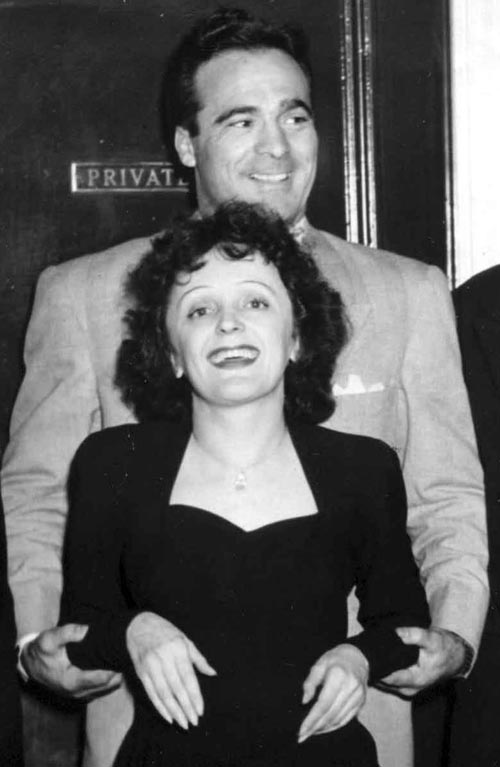
One of my favourite boxers is the great French Algerian World Champ Marcel Cerdan, the tragic lover of singer Edith Piaf, who fought under the moniker of "The Casablanca Clouter" (at least in the US).


Edith & Marcel - She Never Got Over His Death

Cerdan fought Jake La Motta (of Raging Bull fame) for five rounds with a broken shoulder and died in a plane crash en route to a title fight.

In the golden era of sports in the '20s and '30s, the great Boxing writers in particular managed to come up with some right doozies (by the way, that word comes from the US car the Duesenberg, the most luxurious, opulent cars of the 1920s and '30s, the tip top, the very best - "it's a Doozy!").

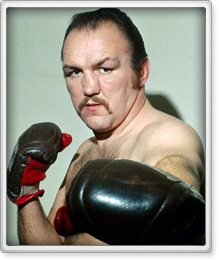
Years ago, I heard of a boxer known as "The Ghost With The Hammer In His Hand" - the brilliant Welsh flyweight Jimmy Wilde. rated by American boxing writer Nat Fleischer, as well as many other professionals and fans including former boxer, trainer, manager and promoter, Charley 'Broadway' Rose, as "the greatest flyweight ever." 


Wilde earned various nicknames such as, "The Mighty Atom" and "The Tylorstown Terror." But the best for him conveyed in eight words his elusive menace, a boxer you couldn't hit, but who could hit you with the force of a hammer.


Jimmy Wilde - The Ghost With The Hammer in His Hand


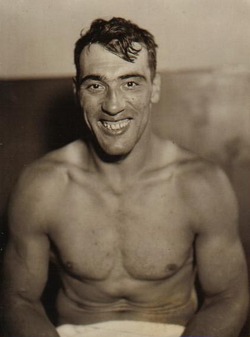
The Ambling Alp


The era also gave us Primo Carnera - and this is another great nickname - a giant Italian with plenty of heart but all the menace of a marshmallow - Carnera was known as "The Ambling Alp". Brilliant. The most danger the hapless Carnera ever posed to opponents was the threat of accidentally falling over on them.

The Gentle Italian Giant was hyped by gangster bookies as the latest in a long line of Great White Hopes, they put him in against patsys - knowing that a Six-Foot-Six Italian would be huge box office in New York and milked him for everything he had. His story inspired the great boxing movie The Harder They Fall, a cynical, noirish 1958 tale of dirty deeds in the boxing business that was Humphrey Bogart's final screen outing.


Primo's story also inspired a great pop song - Yeasayer's Ambling Alp.


* The Bayonne Bleeder

Chuck Wepner was the tough journeyman who had a reputation for bleeding at the lightest touch of a glove - hence the rather cruel nickname the "Bayonne Bleeder". In 1975 he lucked into a fight with Muhammed Ali and went 15 rounds with The Greatest. That particular story inspired Sylvester Stallone to write "Rocky".
Quick Chuck! Bleed on 'im!
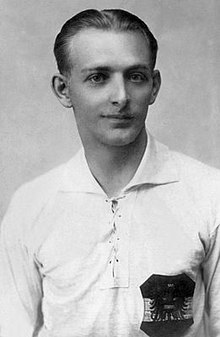
Away from boxing  - the story of the great Matthias Sindelar - the tragic hero of Austrian football has always intrigued me - he defied the Nazis after the Anschluss, embarrassed their great Nazi football team in front of a Viennese crowd and was then found dead - either murdered by the Gestapo or by his own hand - shortly afterwards.

You can read this excellent piece on Sindelar here - Guardian On Sindelar

But I love that his nickname - because of his slight build - was Der Papierene or "The Paper Man". How evocative.


Sindelar - The Paper Man 
These are just a few of my favourite sporting nicknames - it's a subject I may have to return to!

ENDS 

The Redlegs of Barbados - Cromwell's Irish "Slaves" & The Last Emperor of Byzantium.

* Note - there has been a lot of debate and controversy recently over what many call the "myth of Irish Slavery".

It's a complicated issue - personally, I don't go along with "the Irish were slaves too, you know!" argument - partly because you cannot compare what happened to the Irish under Cromwell or later with the centuries long and massive enslavement of Africans in the Americas. So this story of Irish Indentured Servants in the Caribbean is presented with this in mind,


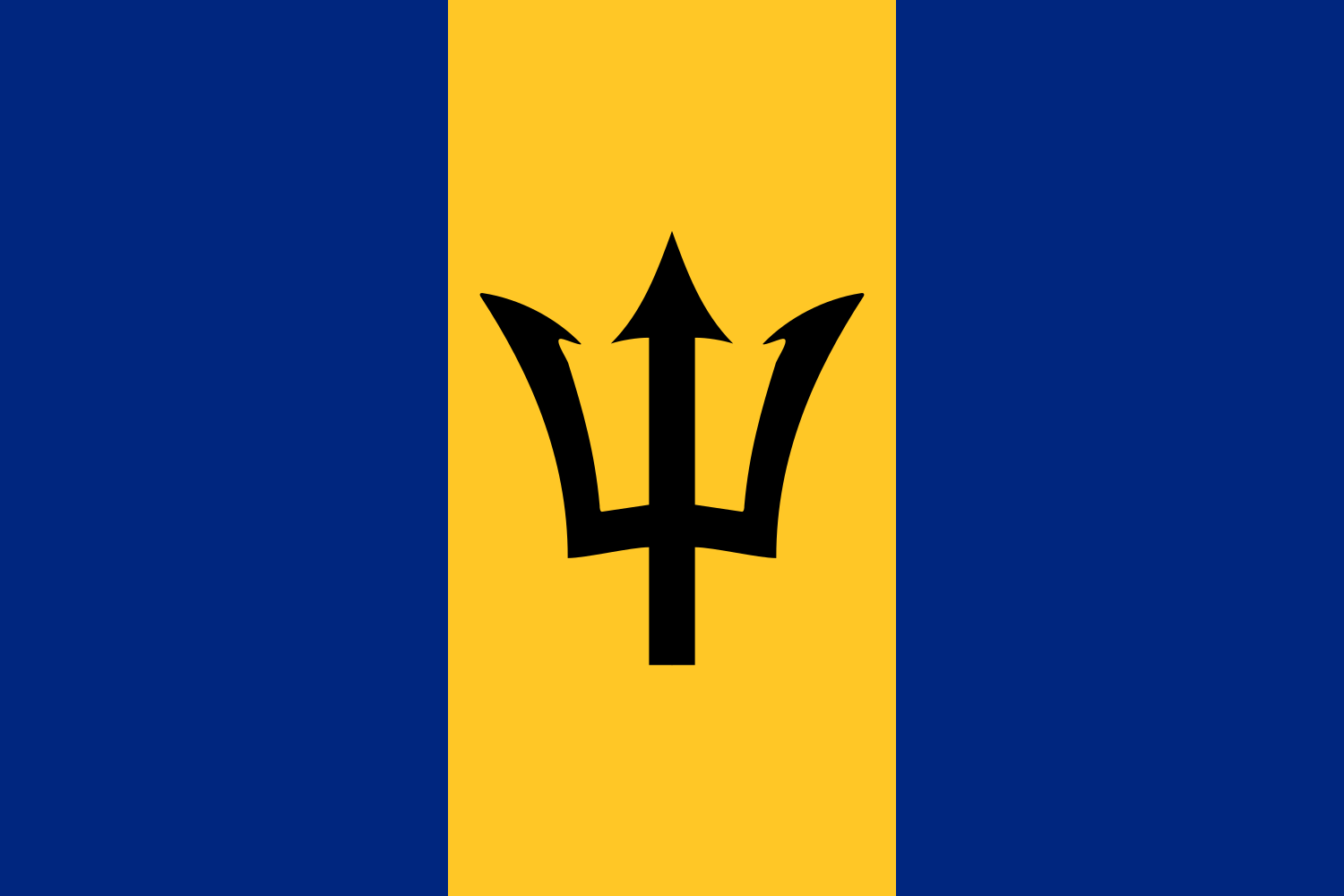
Bajan Flag


* A few years ago, myself and a friend visited another old friend of mine in Barbados, the Caribbean Island that has a history of sugar-cane production, piracy, plantations and slavery going all the way back to the mid-1600s.

We toured some of the old plantations, saw the bells used to call the slaves to work in the sugar-cane fields, the crumbling old planters' mansions and the 18th Cent protestant churches that look as if they have been picked up from the outskirts of an English village and planted in the midst of palm trees and sugar cane fields on the wild Atlantic edge of this tiny Caribbean island.

Old Plantation House - Barbados


Barbados is tale of two coasts - on the calmer western, endless golden beaches, hotels and tourist development. Over on the Atlantic side, the rough seas, driving winds and wild shorelines common to the Windward Islands (it's also where popstar Rhianna is from and she has Irish ancestry through her father's side. He's a Fenty, one of the descendents of the Irish brought over after the Cromwellian conquest. Rhianna also really likes the chain of fast food joints selling Piri-Piri chicken - Chefette. This, and a fabulous singing voice, is all that Rhianna & myself have in common.

It was while we were exploring the wilder side of the island that we had a strange encounter with the descendents of the white Irish slaves brought to Barbados after the Cromwellian conquest of Ireland and the ethnic cleansing that followed. For one version of the story - you can read "To Hell Or To Barbados - : The Ethnic Cleansing of Ireland [Sean O'Callaghan]", a book you can get on Amazon etc. 

But fair warning - it makes an argument that some Irish historians are strongly opposed to - that you can equate or measure the transportation of Irish to the Caribbean with the brutal enslavement of millions of Africans. 

Here's my story of what we came across, strange echoes of a chapter of Irish, English and Caribbean history. And a chance discovery of the last remnant of the Byzantine Empire, on a cliff above the Caribbean shore.


* Redlegs & Ecky-Beckys - The Forgotten Irish Of Barbados 

In 1976, an Irish documentary team went to the Caribbean Island of Montserrat to film the people there, many of whom had descended from Irish families brought to the sugar plantations after the Cromwellian conquest, they had been robbed of their lands and transported as Indentured Servants (or "criminals", rebels and traitors - Catholic, basically). In 17th century, going from Cork or Tipperary to Barbados must have been like travelling to the Moon. The clip below gives you a flavour of the extraordinary echoes of those people and those times that were still heard on the island in the 1970s. Montserrat suffered a cataclysmic volcanic eruption in the '90s but people have returned to the island and it still has a very strong Irish legacy & tradition, they still celebrate St Patrick's Day there every year. 


And you can see the full doc here - it's half an hour long but well worth a look....

Full Doc - The Black Irish

I have been to Barbados several times myself, have a very good friend living there and it's a beautiful island. The Irish were back in the '90s and Noughties, this time buying up holiday homes and hotels as the Celtic Tiger gave us (well,  a few of us) economic power that the first Irish to land on those shores couldn't have dreamed about.


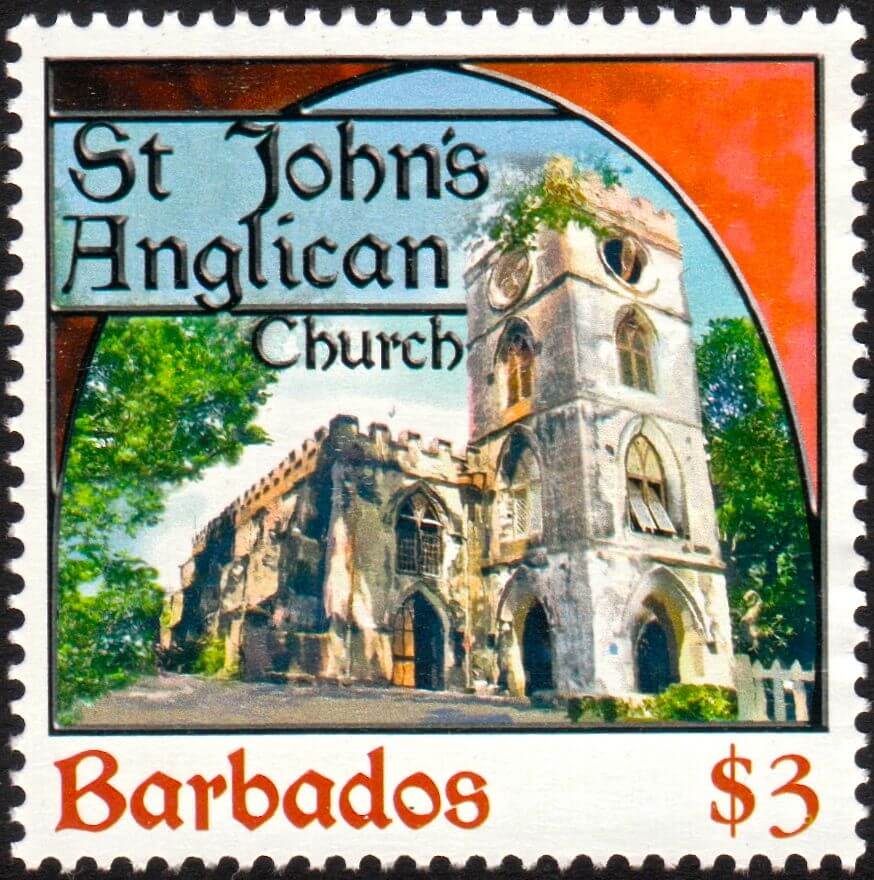
On a trip up to St John's Church - an extraordinary 17th Cent Church (although it has been rebuilt a couple of times) we came across the grave of one Ferdinando Paleologus, a descendent of the brother of the great Emperor Constantine XI. Ferdinando was the last of the Byzantine Imperial family from the 1400’s that produced the last Christian emperors of Greece.

He fled to Barbados after the 1645 Battle of Naseby in England. His family had been driven from the throne of Constantinople by the Turks.

He was a church warden of St. John’s Parish having lived there for 20 years where he owned a 197-acre plantation, which he managed from 1649 to 1670 and later died there in 1678.

When Paleologus died, he was buried in the St John’s Parish Church, since he had been a prominent person in that community. 

The dignified memorial, wrought in Portland stone portrays a Greek temple with Doric columns surrounding the cross of Constantine carved in the centre. The following inscription may still be read:

Here lyeth ye body of
Ferdinando Paleologus
Descended from ye imperial lyne
Of ye last Christian
Emperors of Greece
Churchwarden of this Parish
1655-1656
Vestryman, Twentye years
Died Oct. 3 1678

What a strange story, the last remnant of an ancient empire, itself a remnant of Ancient Rome, washed up on an island on the other side of the Atlantic, not even known to Europeans when his ancestor became the last Empire of Byzantium.

The View From St John's Church - Barbados

Tomb of The Last Emperor of the Greeks
As if finding the grave of the last of the Byzantine Imperial Family in a deserted, cliff top graveyard in the Caribbean wasn't strange enough, we also came across a group of what my Bajan-resident friend told me were Ecky-Becky's or Redlegs - the descendents of the Irish transported to Barbados after Cromwell, people who had worked alongside the black slaves in the sugar fields (often as overseers or foremen) and had then stayed on their hillside farms in the more remote parts of Barbados after the end of slavery.

They are also called the "Poor Whites" and have often been seen or portrayed as something of an underclass, hillbillies, backward, insular people. They were called "Redlegs" because of the colour their pale Celtic skin went in the sun. They are in Barbados and on other islands such as St Vincent & Grenada (they are also not exclusively Irish, the Caribbean has always been a melting pot).

Bajan popstar Rhianna has Irish ancestry on her father's side. Born in the parish of Saint Michael, Barbados on February 20, 1988, her mother Monica Braithwaite, a retired accountant, is a mix of African and Guyanese. (Guyana is located off the northern coast of South America). Her father, Ronald Fenty, was a warehouse supervisor. He is of Barbadian and Irish ancestry. Or as they would say in Barbados, a "Redleg". 


Here's a brief video and some photos from Barbados - and it gives you some sense of what it's like to run into some Ecky-Beckys (nobody's quite sure where this slang term came from) - these are sunburnt Irish faces amongst the more familiar faces of the Caribbean. It's strange seeing faces of what look like West of Ireland or Munster men and then hearing the accents, strong West Indian. The names are Irish, Dixon, McCarthy, O'Brien, the voices are pure West Indian.

They ended up on the other side of the Atlantic because of conquest and clearance, their descendents became an isolated community of Irish people, marooned on a paradise island.

Barbados is changing, more tourism, more money, more development, greater links with the rest of the Caribbean and with the wider world. The Redlegs are a throwback. And there is a sense that they are now very much out of time and place. But it is a fascinating story, nonetheless.

ENDS